
Moving Containers
Recommendation
Moving Container Reviews
Recommendation
Truck Rentals Reviews
Storage Recommendations
Storage Review
Junk Removal Recommendations
Junk Removal Reviews
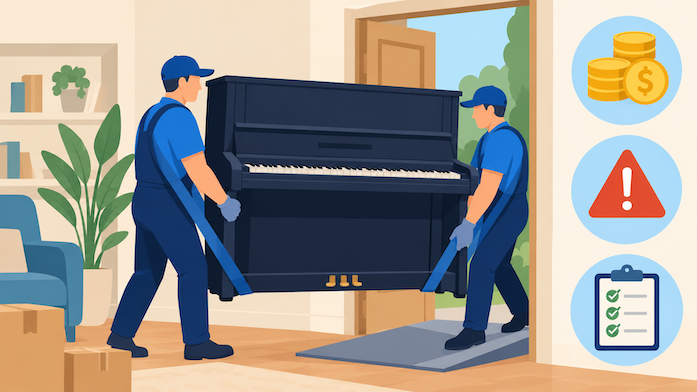

Knowing how to move a piano safely requires specialized equipment, trained movers, and careful planning — doing it wrong risks serious injury and permanent instrument damage. The cost to move a piano typically ranges from $150 to $2,000 or more depending on piano type, distance, and access complexity — with specialty grands on long-distance moves potentially reaching $3,000+.
Piano moving cost is determined by four variables: instrument size, move distance, access difficulty, and whether climate-controlled transport is required.
For a local move — often defined as under 50 miles, though definitions vary by company and state — expect to pay:
| Piano Type | Average Local Cost | Cost With Stairs |
|---|---|---|
| Upright / Console | $150 – $350 | $350 – $600 |
| Baby Grand | $250 – $500 | $500 – $800 |
| Full Grand / Concert Grand | $350 – $600 | $600 – $1,000+ |
These figures represent base rates from specialty piano movers. A standard local moving crew will often quote lower — but that lower price reflects less experience and inadequate equipment, which increases your risk.
Long-distance piano shipping introduces freight logistics, which changes the pricing structure significantly:
| Move Distance | Upright | Baby Grand | Concert Grand |
|---|---|---|---|
| 100–300 miles | $400 – $700 | $600 – $1,000 | $900 – $1,500 |
| 300–1,000 miles | $600 – $1,200 | $900 – $1,600 | $1,200 – $2,000+ |
| Cross-country (1,000+ miles) | $800 – $1,500 | $1,200 – $2,000 | $1,500 – $3,000+ |
Industry sources including HomeAdvisor have reported national average piano moving costs in the range of $400, though figures vary by market and change over time — and specialty grands in difficult-access homes can push costs well above $2,000. These estimates align with what piano movers and full-service moving companies quote across major US markets as of 2025.
A standard upright piano typically weighs somewhere between 300 and 800 pounds depending on the subtype — spinets and consoles tend toward the lower end, while full upright grands sit at the higher end. A baby grand typically weighs roughly 500 to 600 pounds, though figures vary by manufacturer and model. A full concert grand — such as a Steinway Model D, which Steinway lists at approximately 990 pounds — can weigh close to or over 1,000 pounds depending on the instrument. None of these instruments were designed to be moved horizontally, disassembled, or dragged across floors.
The internal structure of a piano includes thousands of moving parts under extreme string tension. A modern concert grand carries an estimated 18 to 20 tons or more of combined string tension on the cast-iron plate, according to various piano technical sources — though the precise figure varies by instrument. Sudden drops, tilting without proper support, or exposure to temperature extremes can crack soundboards, break bridges, or permanently damage the action mechanism.
In practice, the risks fall into two categories:
Injury risk to people. Pianos are dense and have an irregular center of gravity. Without a proper piano board (a reinforced skid board), moving straps rated for instrument transport, and at least two experienced handlers, a piano can shift unpredictably on stairs. The Bureau of Labor Statistics consistently identifies overexertion and bodily reaction — the category that covers lifting and moving injuries — as one of the leading causes of nonfatal workplace injuries. Piano moving amplifies this risk significantly due to the instrument’s weight and shape.
Damage risk to the instrument. Even minor shocks transmit through the cast-iron plate. A superficial bump on the cabinet can cause hairline fractures in the soundboard. These often only become apparent months later, when tonal quality degrades. Valuable or antique instruments require additional protection — some movers wrap grands in climate-controlled blankets and use air-ride suspension trucks to eliminate road vibration.
Not every company that calls itself a “piano mover” has the experience or equipment to justify that label. Here is what to verify before you book.
Ask directly: Do they own piano boards, strap systems designed for instrument transport, and padded blankets specifically for piano cabinets? A legitimate piano mover will answer without hesitation. A general mover improvising with standard furniture pads is a red flag.
Standard general liability insurance may not cover instrument damage. Ask for a certificate of insurance that explicitly includes coverage for the piano itself — not just liability for property damage at the origin or destination. For instruments worth more than $5,000, request the coverage limit in writing before signing.
If your piano is crossing state lines, your mover must be registered with the Federal Motor Carrier Safety Administration (FMCSA). You can verify any mover’s registration and complaint history at the FMCSA’s mover search tool. For more on why this matters, see WowMover’s guide on why you need a licensed interstate mover.
Pricing varies significantly between providers. A quote that is unusually low — more than 30% below the other estimates you receive — is worth scrutinizing. Ask what that quote excludes: stairs, long carries, disassembly, or reassembly of the legs and pedal lyre on grands are common add-on charges that inflate the final bill.
General moving reviews do not tell you whether a company handles instruments well. Search specifically for reviews that mention pianos, grands, or specialty items. WowMover’s guide on reading moving reviews outlines what signals to look for.
Most piano movers charge a stair fee of $40 to $100 per flight of stairs. A second-floor bedroom piano going to a basement music room in a new home could add $80 to $200 to your base quote.
If the truck cannot park within 75 feet of the entry point — common in urban buildings with loading restrictions — movers apply a long-carry fee, typically $50 to $150.
Grand pianos must have their legs, pedal lyre, and lid removed before transport. Reassembly at the destination is standard, but confirm it is included in your quote. Some movers list “delivery” and “set-up” as separate line items.
Solid spruce soundboards and hide glue joints are sensitive to humidity and temperature swings. If your move involves storage or crosses regions with dramatic climate differences, climate-controlled transport adds $150 to $400 but is strongly recommended for instruments valued above $3,000.
If your new home is not ready when the piano needs to leave your current one, short-term piano storage in a climate-controlled facility typically costs $50 to $150 per month depending on the instrument size and location. For more on handling storage timing around a move, see temporary storage between moves.
Preparation on your end reduces the time movers spend on-site — and time is often the primary cost driver.
The idea of moving a piano yourself to save $300 to $600 appears financially logical. In practice, it consistently goes wrong in one of three ways.
First, most rental furniture dollies are not rated for piano weight or are too narrow for the instrument’s base. Second, standard moving straps attach to corners and edges that were not designed as lifting points on a piano — on an upright, this leads to cabinet stress fractures. Third, amateur crews underestimate the weight distribution shift when navigating ramps and stairs, which is when most drop incidents occur.
Beyond the instrument, there is personal liability. If a helper is injured during an unpaid DIY move in most states, you carry potential liability for medical costs. If a professional mover is injured due to conditions you created — an unclear path, inadequate lighting — that expands your exposure further.
The honest cost-benefit calculation: the savings from DIY rarely exceed the deductible on a piano repair claim, let alone the cost of a damaged instrument. For a Steinway, Yamaha grand, or any instrument worth more than $2,000, the DIY option is not a real option.
Temperature and humidity changes during transit cause wood to expand and contract, which shifts the tension on strings. This means every piano — regardless of how carefully it was moved — goes out of tune during relocation.
The standard recommendation from piano technicians is to wait until the instrument has fully acclimated to the humidity and temperature of the new space before scheduling a tuning appointment — commonly suggested as anywhere from two to six weeks. If you tune immediately after the move, the pitch will shift again as the piano settles — making that tuning appointment wasted money.
For pianos that have not been tuned in more than a year prior to the move, or instruments that experienced significant climate change during transit, a pitch raise (a separate service from standard tuning) may be required before fine tuning is possible. Budget $100 to $200 for tuning; pitch raises add another $50 to $100.
Moving an upright piano locally — within 50 miles — typically costs between $150 and $350 for a single-story move. Add $40 to $100 per flight of stairs. Prices vary by market, so get at least three quotes from specialty piano movers rather than general moving companies.
Standard moving crews can physically attempt to move a piano, but most are not equipped with piano boards, instrument-rated straps, or the training to navigate stairs safely with an instrument this heavy. Many general moving companies explicitly exclude pianos from standard coverage under their insurance policies. Always hire a mover with documented experience moving your specific type of piano.
Standard homeowners insurance policies generally exclude property in transit. Some policies offer a rider for scheduled personal property — if your piano is listed as a scheduled item, off-premises coverage may apply. Confirm with your insurer before the move, and do not assume coverage exists. The mover’s own cargo insurance is your primary protection.
A local upright piano move from one house to another takes between 1.5 and 3 hours for a professional crew, including loading, transit, unloading, and placement. A grand piano move takes longer — typically 2.5 to 5 hours — due to disassembly and reassembly of legs and the pedal lyre. Long-distance moves depend on routing and whether the piano travels on a dedicated truck or shared freight.
Piano movers transport and place the instrument — they do not tune it. You will need to hire a separate piano technician. Most movers can recommend a tuner in your area, but the tuning appointment and cost ($100 to $200) are entirely separate from the moving service.
The lowest-cost legitimate option for long-distance piano moves is consolidated freight — sometimes called shared-load or grouped shipping — where your piano travels with other items in a larger shipment. This reduces cost but extends delivery windows to 1–3 weeks. For instruments worth less than $1,500, this is a reasonable trade-off. For valuable instruments, a dedicated piano transport service with a specific delivery date is the safer choice despite the higher cost.
Moving a piano is one of the few relocation tasks where hiring a specialist is not optional — it is the only financially sensible path. Get quotes from at least three specialty piano movers, confirm instrument-specific insurance in writing, and schedule a tuning appointment three to four weeks after delivery. If you are coordinating a full household move alongside the piano, WowMover’s moving company matching service can help you find movers experienced with specialty items in your area.
