
Moving Containers
Recommendation
Moving Container Reviews
Recommendation
Truck Rentals Reviews
Storage Recommendations
Storage Review
Junk Removal Recommendations
Junk Removal Reviews
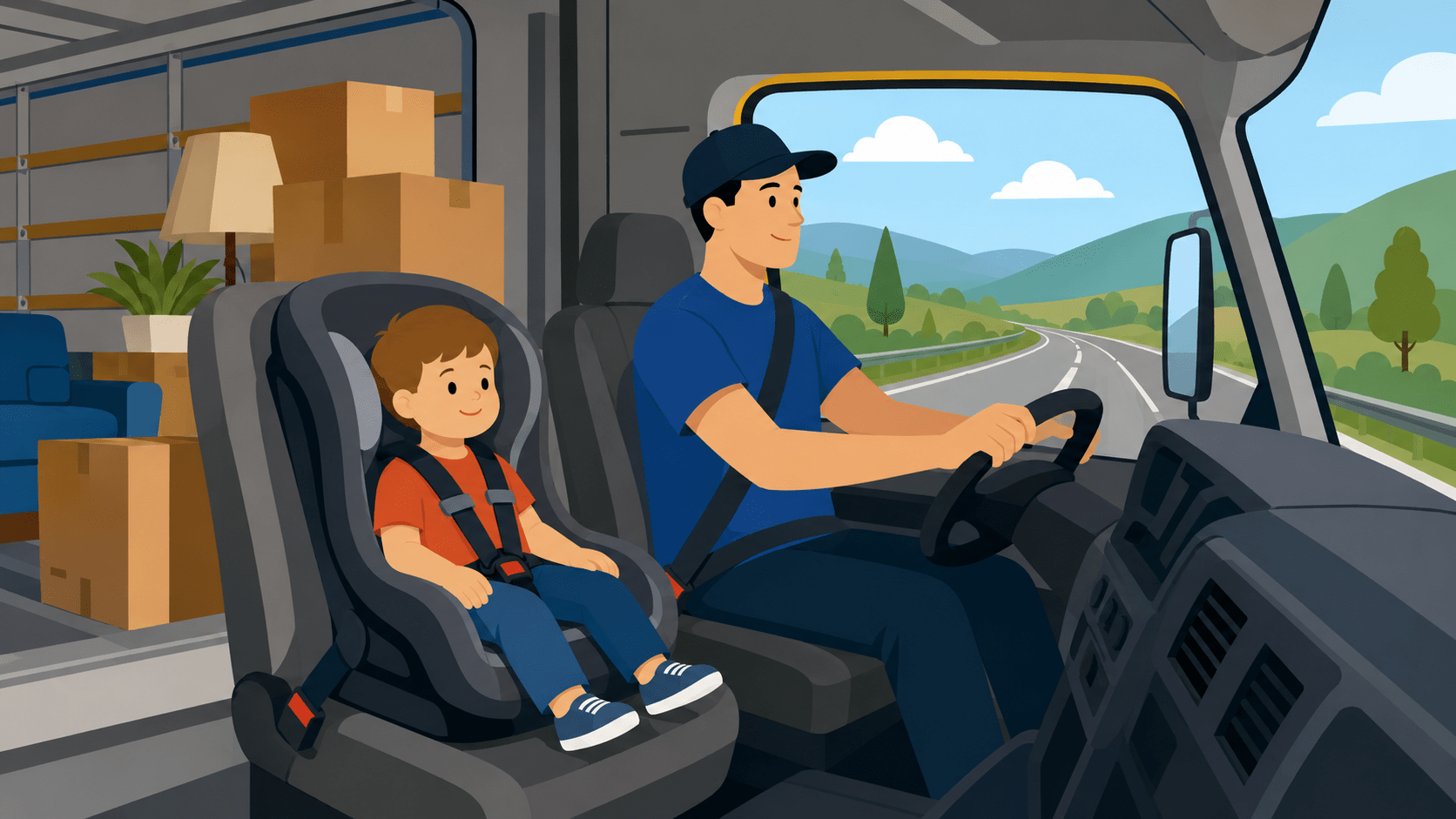

Moving with children adds another layer of planning to an already stressful process. One of the most common questions parents ask is whether it’s safe to place a car seat inside a moving truck during a relocation.
While the idea may seem practical, the answer isn’t as straightforward as many people expect. Although some moving trucks have passenger seats equipped with seat belts, they are not designed with child passenger safety as a primary consideration.
Before deciding whether your child should ride in a moving truck, it’s important to understand the safety risks, legal considerations, and safer alternatives available during your move.
When families rent a moving truck, they often focus on transporting furniture, boxes, and household belongings. However, transporting children requires a completely different set of considerations.
Unlike passenger vehicles, most moving trucks are designed primarily for cargo transportation. The cabin area is typically built for one to three adult occupants and may not include the safety features commonly found in family vehicles.
This creates challenges when attempting to install a child safety seat properly.
In many cases, parents discover that while a car seat may physically fit inside the truck, that doesn’t automatically make it the safest option.
The legality of placing a car seat in a moving truck varies depending on the state and the specific type of truck being rented.
There is no universal federal law that specifically prohibits installing a child car seat in a moving truck. However, child passenger safety laws generally focus on proper restraint systems and approved seating positions.
Because regulations differ by state, it’s essential to review local laws before your move. Additionally, rental truck companies often leave the responsibility of compliance to the driver rather than providing definitive guidance.
For this reason, parents should never assume that because a car seat can be installed, it is automatically legal or recommended.
Most truck rental companies avoid making direct recommendations regarding child car seat installation.
Their trucks are designed primarily for transporting cargo and adult occupants rather than families with young children. As a result, rental providers generally instruct customers to follow state laws and manufacturer guidelines regarding child passenger safety.
Unlike passenger vehicles, moving truck companies do not typically provide child restraint systems or specialized seating accommodations.
This means the responsibility for determining whether a car seat can be safely installed falls entirely on the renter.
Before your move, consider researching local moving company that can transport your belongings while your family travels separately in a safer vehicle.
Even when a car seat can technically be secured inside a moving truck, several safety concerns remain.
The safest location for a child car seat is generally the rear seat of a passenger vehicle.
Most moving trucks do not have a rear seating area. Instead, children would be positioned in the front passenger seat, which introduces additional risks.
Without a back seat, parents lose one of the most important safety advantages available in modern vehicles.
Passenger-side airbags are designed to protect adults during collisions.
For young children, however, airbags can be dangerous and potentially cause serious injuries when deployed.
Many child safety experts recommend that children under a certain age avoid riding in front-seat positions whenever possible.
If a child must ride in a moving truck, parents should verify whether the passenger-side airbag can be deactivated.
Driving a moving truck requires more concentration than driving a standard car.
Large trucks have:
Longer stopping distances
Larger blind spots
Different turning requirements
Increased susceptibility to wind conditions
When a child requires attention during a long trip, distractions can increase the likelihood of accidents.
Whenever possible, consider transportation options that allow your child to travel in a standard passenger vehicle equipped with appropriate safety features.
One parent can drive the moving truck while the other drives the family vehicle.
This arrangement allows children to remain safely secured in familiar seating positions while reducing safety concerns associated with moving truck cabins.
Many families choose portable storage services instead of driving a moving truck themselves.
Using a portable moving container service for long-distance relocations allows your belongings to be transported while your family travels comfortably in your own vehicle or by air.
For smaller moves, towing a trailer behind a family vehicle can be a practical solution.
This option keeps children safely seated in the back seat while still allowing you to handle the move yourself.
Regardless of how you travel during your move, selecting the proper car seat is essential.
Rear-facing car seats provide the highest level of protection for infants and toddlers.
These seats distribute crash forces more evenly across the child’s body and significantly reduce the risk of severe injury.
Current safety recommendations generally encourage children to remain rear-facing as long as they meet the seat manufacturer’s height and weight requirements.
Forward-facing seats are designed for children who have outgrown rear-facing models.
These seats use a harness and tether system that helps limit movement during sudden stops or collisions.
Proper installation is critical to ensure maximum effectiveness.
Booster seats help position a child correctly so the vehicle’s seat belt fits properly.
Children typically transition to booster seats after outgrowing forward-facing harness seats.
The goal is to ensure the lap and shoulder belts rest correctly across the child’s body rather than the neck or abdomen.
Although alternative transportation is generally recommended, some families may have no practical choice.
If your child must ride in a moving truck, several precautions can help reduce risk.
Before departure, confirm that the truck’s seating system can properly accommodate your child’s car seat.
Follow both the truck manufacturer’s instructions and the car seat manufacturer’s installation guidelines.
Ask the rental company whether the passenger-side airbag can be turned off.
A deactivated airbag may reduce injury risks associated with front-seat placement.
Position the passenger seat as far away from the dashboard as possible.
Increasing the distance between the child and the airbag can provide an additional margin of safety.
Safe driving becomes even more important when transporting children.
Maintain longer following distances, obey speed limits, avoid aggressive maneuvers, and plan your route in advance to minimize stress and distractions.
If you’re trying to reduce moving expenses while maintaining safety, renting the cheapest moving truck without sacrificing reliability can help you make more informed decisions.
One of the most confusing aspects of this topic is the variation in state laws.
Some states have specific requirements regarding:
Child age
Weight limits
Height restrictions
Approved restraint systems
Seating position requirements
Because moving trips often cross multiple state lines, families should review regulations for every state included in their route.
Law enforcement officers may also exercise discretion regarding child passenger safety situations involving commercial or rental trucks.
If authorities advise against transporting a child in a moving truck, it is best to follow their recommendations.
Moving day can be hectic, making it easier to overlook important safety details.
Some common mistakes include:
Even a high-quality car seat offers limited protection when installed improperly.
Double-check installation before departure.
Saving time is never worth increasing the risk to your child.
Whenever possible, choose transportation methods specifically designed for family travel.
Children may become uncomfortable during long drives.
Scheduling breaks can reduce distractions and improve overall travel safety.
Moving trucks handle very differently than passenger vehicles.
Parents should familiarize themselves with truck operation before beginning a long-distance move.
It depends on the truck’s seating configuration and seat belt system. However, safety experts generally prefer children travel in a standard passenger vehicle whenever possible.
Most moving trucks do not include the same LATCH anchor systems found in passenger vehicles. Always verify compatibility before attempting installation.
Not necessarily. Laws vary by state and vehicle classification. Review child passenger safety regulations for every state along your route.
The safest option is usually transporting children in a properly equipped passenger vehicle while the moving truck is driven separately.
If permitted by the truck manufacturer and rental company, disabling the passenger-side airbag may reduce injury risk. Always follow manufacturer instructions.
While it may be technically possible to install a car seat in some moving trucks, that doesn’t necessarily make it the safest choice.
Moving trucks are designed for transporting belongings, not children. The absence of rear seating, potential airbag risks, and the unique challenges of operating a large vehicle all contribute to increased safety concerns.
Whenever possible, arrange for your child to travel in a passenger vehicle equipped with appropriate safety features and properly installed child restraints. Taking extra precautions during your move can help ensure that every member of your family arrives safely at your new home.
