
Moving Containers
Recommendation
Moving Container Reviews
Recommendation
Truck Rentals Reviews
Storage Recommendations
Storage Review
Junk Removal Recommendations
Junk Removal Reviews
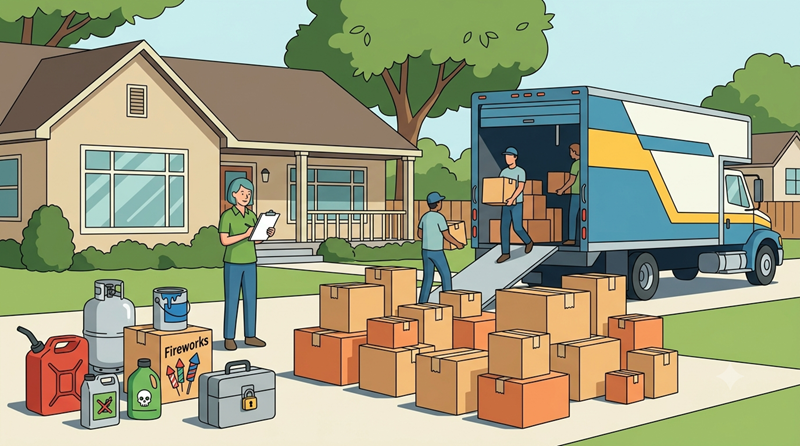

An interstate move involves more than loading boxes into a truck and heading to a new state. Certain household products can create safety risks, violate carrier policies, or cause serious problems during transportation. Knowing the prohibited items for moving before packing day helps prevent delays, damaged belongings, and unnecessary complications.
Federal rules and moving-company policies can vary by item and transportation method. FMCSA notes that interstate household-goods moves are governed by federal regulations, while dangerous or hazardous materials can also affect a mover’s liability.
Understanding prohibited items for moving starts with knowing why carriers restrict certain household goods. A moving truck contains many different possessions in an enclosed space, often traveling hundreds or thousands of miles.
A leaking chemical, combustible liquid, pressurized container, or damaged battery can create a serious safety hazard. Some materials are also regulated by federal transportation rules, while others may be restricted by individual moving companies.
FMCSA specifically warns that placing dangerous or hazardous materials into household goods without informing the mover can affect liability protection.
That makes a pre-move inspection worthwhile. Instead of discovering a restricted product on moving day, separate questionable items several days before the crew arrives.
Gasoline, diesel, kerosene, lighter fluid, and similar combustible liquids belong near the top of any prohibited items for moving checklist.
These products can leak, produce flammable vapors, or ignite during transportation. Even a nearly empty fuel container may still contain dangerous vapors.
Fuel-powered equipment such as lawnmowers, chainsaws, and certain outdoor tools also deserves attention. Drain fuel according to the equipment manufacturer’s instructions and follow local disposal requirements.
Never assume that an empty-looking container is automatically safe for shipment. Ask the moving company about its specific requirements before loading any fuel-related product.
Propane cylinders, camping gas canisters, oxygen cylinders, and other pressurized containers are common examples of prohibited items for moving.
A sealed cylinder can remain pressurized even when it appears unused. Changes in temperature, handling, or damage can create dangerous conditions.
Common examples include:
Proper disposal, recycling, or return programs are generally safer alternatives than placing these containers inside a household shipment.
Fireworks and explosive materials should never be treated as ordinary household belongings. They can pose significant fire and blast risks during transportation.
Ammunition also requires special consideration. Firearm transportation is not universally prohibited, but rules depend on the firearm, ammunition, destination, carrier, and applicable state and local laws.
The ATF states that a person who lawfully possesses a firearm may transport or ship it interstate during a change of residence, but the mover must be notified and certain NFA firearms can have additional requirements.
For that reason, firearms and ammunition should be discussed with the mover well before moving day rather than quietly placing them inside a box.
Paint thinner, turpentine, certain paints, solvents, pool chemicals, acids, and other strong chemical products can fall among the prohibited items for moving because of their flammability, toxicity, corrosive properties, or other transportation risks.
A tightly closed container does not automatically make a chemical suitable for shipment.
Create a separate collection of products from the garage, workshop, basement, and cleaning cabinet. Check product labels and local household hazardous-waste programs for safe disposal or recycling options.
A professional mover can also tell you whether a specific product is accepted, restricted, or completely excluded.
For specialized guidance, review this resource on how to properly move hazardous materials before packing questionable chemicals.
Pesticides, herbicides, insecticides, fertilizers, and concentrated garden treatments are another category that deserves special attention.
These products may contain toxic or reactive ingredients and can create problems when packed alongside furniture, clothing, food, or children’s belongings.
Do not transfer chemicals into unmarked containers simply to make them easier to transport. Product labels provide important information about handling and disposal.
Instead, identify the products early and check local disposal requirements. This is one of the easiest ways to reduce the number of prohibited items for moving that appear at the last minute.
Perishable food is often overlooked because it does not seem dangerous. Yet refrigerated or frozen products can spoil during a long-distance journey.
Meat, dairy products, frozen meals, fresh produce, and opened refrigerated foods are poor candidates for a cross-country shipment.
Nonperishable pantry goods may be acceptable depending on the mover, but glass jars, liquids, and open packages still require careful packing.
A useful rule for prohibited items for moving is to separate anything requiring refrigeration from shelf-stable foods several days before departure. Use what you can, donate unopened products, and dispose of food that cannot safely travel.
Moving houseplants across state lines can involve restrictions that go beyond ordinary household packing. Certain plants, soil, pests, and plant materials may be regulated because states work to prevent the spread of agricultural pests and diseases.
That means plants should not simply be placed inside a moving box without checking the destination state’s requirements.
For practical preparation, this plant parent guide for moving houseplants safely can help with the planning process.
The same principle applies to seeds, garden soil, and outdoor materials. Regulations can differ by destination, so checking before moving is much easier than dealing with a restricted plant at the destination.
Aerosol cans, corrosive cleaners, certain batteries, strong adhesives, and specialty chemicals can create transportation concerns even when they are common household products.
A useful hazardous items list should include products from the garage, workshop, utility room, kitchen, and bathroom rather than focusing only on obvious chemicals.
Battery-powered electronics also deserve attention. Lithium batteries have specific transportation requirements, and their acceptability can depend on whether they are installed in equipment, packed with equipment, or shipped separately. USPS rules, for example, impose different conditions depending on battery type and configuration.
When a product has a warning label, unusual packaging, or specialized handling instructions, verify its status before putting it into a moving box.
Not everything that should stay off the moving truck is dangerous. Some belongings are better kept with you because replacing them would be difficult or impossible.
Passports, birth certificates, financial records, property documents, cash, jewelry, small collectibles, and irreplaceable photographs should generally travel separately in secure personal luggage.
This is an important part of understanding prohibited items for moving from a practical perspective: a moving company’s restrictions are not the only consideration. Personal security and accessibility matter too.
Keep essential documents together in a clearly organized travel folder. Valuable jewelry and small high-value items should remain under your direct control throughout the journey.
For delicate collections, these tips on packing fragile glassware and collectibles can help reduce damage during the broader packing process.
The final category of prohibited items for moving is less obvious: products that may not be universally forbidden but are excluded by a particular carrier.
Moving companies can maintain their own policies based on safety requirements, insurance, equipment, transportation methods, and applicable regulations.
Before packing, ask the mover for its current restricted-item policy. Compare that list with your garage, kitchen, bathroom, storage areas, and outdoor spaces.
The best approach to prohibited items for moving is verification rather than assumption. A product accepted by one carrier may not be accepted by another.
A complete what not to pack when moving checklist should go beyond the obvious items. Look through every room and storage area for fuel, chemicals, compressed containers, perishables, plants, valuables, and other products requiring special treatment.
A simple sorting system can make the process easier:
Place documents, medications, valuables, electronics, essential clothing, and important personal items in a separate travel bag.
Set aside chemicals, fuels, fireworks, damaged batteries, and other restricted products for appropriate disposal.
Ask about unusual tools, specialty equipment, plants, firearms, batteries, and other questionable belongings before packing them.
Once restricted products have been removed, ordinary household goods can be organized and protected according to their material and fragility.
For households trying to reduce packaging waste, these suggestions for packing without bubble wrap for moving offer practical alternatives for protecting everyday possessions.
Creating a written checklist makes prohibited items for moving much easier to identify.
Start approximately two weeks before moving day. Walk through the property with a phone or notepad and inspect areas that are easy to overlook.
Pay particular attention to:
Mark each questionable product for disposal, personal transportation, or mover confirmation.
This approach also gives you time to find appropriate disposal options instead of making rushed decisions on moving day.
Removing prohibited items for moving does not mean sacrificing protection for the belongings that can travel.
Glassware, artwork, electronics, furniture, and collectibles still need suitable materials and careful handling. A little preparation can significantly reduce breakage.
Reducing packaging waste can also make the move more efficient. These resources on finding eco-friendly packing supplies can help households find reusable or lower-waste options.
For a broader comparison of professional movers, review the best interstate moving companies and compare services before choosing a carrier.
The final inspection is where many prohibited items for moving mistakes can be prevented.
Walk through the property one more time and check every cabinet, shelf, drawer, garage corner, and outdoor storage area. Remove anything that the mover has identified as restricted.
Keep personal essentials and valuable belongings separate from the shipment. Make sure the moving crew knows about any item that requires special handling.
Federal guidance makes clear that interstate moving has specific consumer-protection requirements, and FMCSA regulations apply to interstate household-goods carriers.
A careful final review protects your belongings, reduces delays, and helps the move start on the right foot.
Knowing the prohibited items for moving before packing begins can make an interstate relocation safer, cleaner, and more predictable.
The goal is not simply to empty the house into boxes. It is to identify items that require disposal, special transportation, personal handling, or confirmation from the carrier.
Start early, review the mover’s current restrictions, and separate questionable products before moving day. With that preparation complete, the remaining household goods can be packed with greater confidence and fewer last-minute surprises.
Common examples include gasoline, propane, explosives, certain chemicals, pesticides, and other dangerous materials.
Some ordinary cleaning products may be accepted, but corrosive, flammable, or otherwise hazardous products can be restricted.
Lawfully possessed firearms may be transported during an interstate move, but federal, state, local, and mover requirements must be checked first.
Important documents, cash, jewelry, and irreplaceable valuables are generally better kept with you rather than placed in the household shipment.
The main categories include dangerous chemicals, fuels, explosives, compressed gases, perishables, restricted plants, and items your mover specifically excludes.
