
Moving Containers
Recommendation
Moving Container Reviews
Recommendation
Truck Rentals Reviews
Storage Recommendations
Storage Review
Junk Removal Recommendations
Junk Removal Reviews

Downsizing from a two-bedroom apartment can make moving feel more manageable, but figuring out how many boxes you actually need is often harder than expected. You may have fewer belongings after decluttering, yet books, kitchenware, clothing, décor, electronics, and everyday essentials can quickly add up.
For most downsizing moves, a good starting estimate is 30–50 boxes, although the right number depends on how much you own and how aggressively you are downsizing. Planning your supplies before moving day can prevent last-minute shopping, unnecessary expenses, and poorly packed items.
There is no single box count that works for every apartment. The number depends on the number of residents, storage space, furniture, hobbies, and the amount of decluttering you complete.
As a general guide, a downsizing two-bedroom apartment may require:
That puts the typical range at approximately 30–50 boxes. If the apartment has a large storage area, extensive kitchen equipment, or several closets packed with belongings, you may need more.
On the other hand, someone who has already removed unwanted possessions may need considerably fewer.
A downsizing move is different from a standard relocation because the goal is not simply to transport everything you own. You are intentionally reducing the volume of possessions before moving into a smaller space.
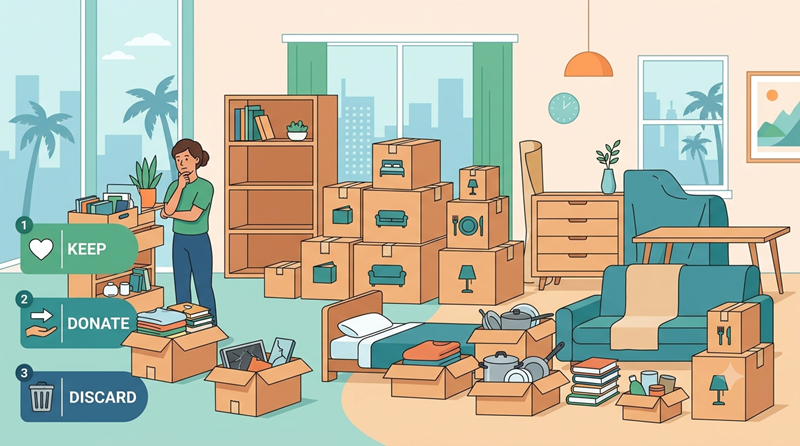
Start by separating belongings into four groups: keep, donate, sell, and discard. Complete this process before buying all your supplies. Otherwise, you may purchase containers for items that never make it to the new apartment.
For example, if you eliminate half the contents of a storage closet, you could save several boxes before packing even begins.
This is especially important when you are moving from a two-bedroom apartment into a smaller apartment or home. Learning how to downsize to a one-bedroom apartment can also help you think more strategically about what deserves space in your new home.
Breaking your belongings down by room makes the estimate much easier.
A bedroom commonly requires boxes for clothing, shoes, bedding, accessories, books, décor, and personal belongings.
You may need around 8–12 boxes per bedroom, depending on closet size and storage habits. Use smaller containers for heavy belongings and larger ones for lightweight bedding.
If you have already reduced your wardrobe, this number can drop significantly.
The kitchen is often one of the most challenging areas to pack because it contains many small and fragile objects.
Allow roughly 8–12 boxes for dishes, cookware, appliances, pantry items, utensils, glasses, and miscellaneous kitchen supplies.
Avoid putting too many heavy items into one container. A box filled entirely with plates or cookware can become difficult and unsafe to lift.
A living room may require approximately 5–10 boxes for books, electronics, decorations, games, lamps, small furnishings, and other loose items.
Large furniture generally does not go into boxes, but its removable components and accessories may need separate packing.
Bathrooms, laundry areas, and utility closets usually need fewer containers, but they are easy to underestimate.
Plan for around 3–5 boxes for towels, toiletries, cleaning supplies, small appliances, and miscellaneous items. Check product labels before packing liquids and keep anything that could leak away from clothing and paper goods.
The number of containers matters, but the type of container matters just as much.
Small boxes are ideal for books, canned goods, tools, and other heavy items. Medium boxes are useful for most household belongings, while large boxes are better suited to lightweight items.
You can also look for cheap moving boxes when your budget is limited, but don’t sacrifice strength simply to save a few dollars.
The goal is to create packages that are secure, stackable, and comfortable to carry.
Downsizing already reduces the volume of your move, but there are additional ways to keep packing costs under control.
Ask local businesses whether they have clean, sturdy cartons available for reuse. Grocery stores, bookstores, offices, and liquor stores sometimes have suitable containers, although you should avoid boxes that are damp, damaged, or contaminated.
You can also reuse or recycle moving boxes after the move instead of sending every container directly to the trash.
Some movers also find free moving boxes through neighborhood groups, community networks, or friends who have recently relocated.
Efficient packing is about more than filling every available space. It is about protecting belongings while keeping the total volume under control.
Begin with things you rarely use. Seasonal clothing, decorative items, spare linens, books, and rarely used kitchen equipment can usually be packed well before moving day.
For fragile possessions, use towels, clothing, paper, or other appropriate household materials as cushioning. If traditional protective materials are unavailable, this guide to packing without bubble wrap for moving offers practical alternatives.
Label every container with its destination room and a brief description of its contents. A simple system such as “Kitchen – Everyday Dishes” is much more useful than writing only “Kitchen.”
Packing an entire two-bedroom apartment can take several days, particularly when you are working, caring for family members, or managing a complicated downsizing project.
Professional help may be worthwhile when you have fragile possessions, limited time, valuable belongings, or difficulty handling the physical work.
Before choosing a provider, take time to understand how to hire the right packing services. Compare the services included, packing materials, experience, insurance coverage, and pricing rather than choosing solely on the lowest quote.
Professional assistance can also make the transition smoother when the moving timeline is tight.
If your downsizing move involves stairs, elevators, narrow hallways, parking restrictions, or heavy furniture, professional movers can reduce much of the physical workload.
Searching for apartment movers near me can help you identify services that understand the practical challenges of apartment relocations.
For a longer-distance move, compare experienced providers and review guides to the best interstate moving companies before making a decision.
The right moving team should be able to explain the estimate clearly and tell you what is included in the quoted price.
Once you have decluttered, estimate your containers by room and then add a small buffer.
For example, if your initial estimate is 35 boxes, purchasing or sourcing around 40 can provide enough flexibility without creating a large surplus.
Keep approximately 5–10 percent of your supplies available for last-minute items. Closets, drawers, cabinets, and storage spaces often produce belongings you did not notice during your first estimate.
At the same time, avoid buying dozens of extra boxes “just in case.” Excess supplies can encourage you to keep things that you originally intended to remove.
For most downsizing two-bedroom apartments, 30–50 boxes is a practical starting estimate. Your actual number will depend on how much you own, how much you eliminate, and how efficiently you pack.
The smartest approach is to declutter first, estimate supplies by room, choose appropriate box sizes, and keep a small reserve for unexpected items. This gives you enough flexibility without wasting money on containers you do not need.
Most importantly, remember that downsizing is an opportunity to make the move simpler. Every item you decide not to transport means less packing, less carrying, less unpacking, and more usable space in your new home.
Most downsizing two-bedroom apartments require about 30–50 boxes, depending on how much you remove before packing.
Small and medium boxes work best for heavy household goods, while large boxes are better for lightweight items.
It is better to declutter first so you do not spend money on containers for belongings you will not move.
Donate, sell, recycle, or discard unwanted possessions before packing the items you plan to keep.
Professional packing can be worthwhile when you have limited time, fragile belongings, or a demanding moving schedule.
