
Moving Containers
Recommendation
Moving Container Reviews
Recommendation
Truck Rentals Reviews
Storage Recommendations
Storage Review
Junk Removal Recommendations
Junk Removal Reviews
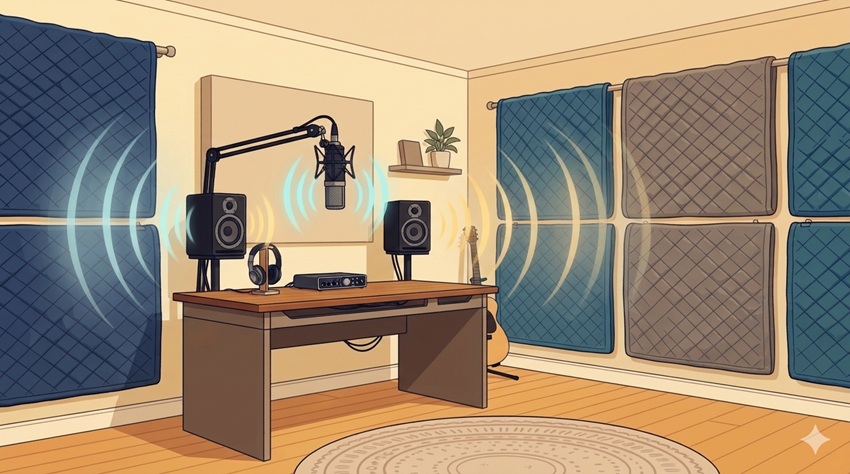

Moving blankets are commonly used to protect furniture, appliances, and other household belongings during relocation. However, their thick, padded construction also makes people wonder whether they can help reduce unwanted noise. Are moving blankets good for soundproofing, or are they simply designed to protect items from scratches and damage?
The answer depends on what you expect them to do. Although soundproof moving blankets can help absorb sound reflections, reduce echoes, and improve room acoustics, they are not a complete solution for blocking noise between rooms. Understanding their capabilities can help you decide whether they are worth using for a home studio, office, apartment, or temporary recording space.
Yes, moving blankets can help with certain sound-control problems, but their effectiveness has limitations.
Most moving blankets are manufactured using thick woven fabrics, cotton blends, polyester, or recycled textile fibers. Their soft, fibrous construction can absorb some sound energy rather than allowing it to reflect from hard surfaces.
This makes them useful for reducing echoes and excessive reverberation in rooms with bare walls, floors, and ceilings.
However, there is an important distinction between sound absorption and soundproofing. Absorption improves the sound quality within a space, while soundproofing aims to prevent noise from travelling between different areas.
Therefore, soundproof moving blankets should be considered a supplementary noise-control option rather than a replacement for properly constructed acoustic barriers.
To understand their effectiveness, it helps to know how sound behaves inside a room.
When sound waves travel through an indoor space, they bounce off hard surfaces such as concrete walls, glass windows, wooden floors, and ceilings. These reflections can create echoes and make conversations, music, and other sounds seem louder or less clear.
Soft, porous materials can absorb some of this reflected sound energy.
Moving blankets work through a similar principle. Their layered textile construction provides a surface that can absorb some sound reflections, helping create a less reverberant environment.
Here are three ways they can help.
Rooms with minimal furniture and hard surfaces often produce noticeable echoes. Hanging thick soundproof moving blankets on selected walls can reduce some of these reflections.
This can make speech sound clearer and improve the overall listening experience.
Textile materials are generally more effective at absorbing certain mid- and high-frequency sounds than deep bass frequencies.
For example, they may help control sharp vocal reflections, keyboard sounds, and some everyday indoor noise.
However, they are unlikely to eliminate deep bass from subwoofers, heavy machinery, or traffic.
Hanging blankets around a small recording area can help reduce sound reflections and create a more controlled environment.
This is particularly useful for temporary workspaces, podcast corners, and home recording setups where permanent acoustic modifications are not practical.
Not every blanket provides the same acoustic performance. Material, thickness, density, and construction all influence how well a blanket absorbs sound.
When comparing soundproof moving blankets, consider the following characteristics.
Thicker blankets generally provide more material for sound waves to interact with. A dense, multilayered design may offer better sound absorption than a lightweight, single-layer alternative.
However, weight alone does not guarantee acoustic performance.
Quilted blankets typically contain multiple fabric layers stitched together with internal padding. This construction creates a thicker surface that can help absorb some sound reflections.
Look for tightly constructed products with consistent padding and durable stitching.
Cotton, polyester, and other fibrous textiles can provide useful sound-absorbing properties.
The actual performance depends on the material structure, thickness, density, and installation method.
For a better understanding of available options, explore different types of moving blankets before selecting a product for your requirements.
Proper placement makes a difference when using blankets to improve room acoustics. Simply placing one over a chair or folding it in a corner will not provide the same results as covering the surfaces responsible for unwanted reflections.
Here are some practical ways to use them.
Start with the walls that produce the strongest sound reflections. Hang blankets using sturdy hooks, suitable mounting hardware, or a freestanding support system.
Covering selected reflective surfaces can help reduce reverberation.
Avoid attaching heavy blankets using weak adhesive strips that may fail under their weight.
Doors and windows are common pathways for unwanted noise. A thick blanket placed over a door or window may absorb some sound inside the room and provide limited additional reduction.
However, gaps around doors and windows can allow considerable noise to pass through. Proper weatherstripping and sealing are generally more effective for addressing these openings.
Keep blankets away from heaters, electrical equipment, and other potential fire hazards.
A portable frame or garment rack can support blankets around a small recording area.
This arrangement helps reduce nearby reflections and may improve microphone recordings, especially when the surrounding room has hard surfaces.
Leave enough space for ventilation and safe movement.
Large untreated walls can contribute significantly to room reverberation.
Rather than covering every surface, identify the areas where reflections are most noticeable and position blankets accordingly.
This approach can provide useful acoustic improvements without making the room unnecessarily enclosed.
Both products can improve room acoustics, but they serve different purposes and have different advantages.
| Feature | Moving Blankets | Acoustic Panels |
| Main purpose | Furniture protection and temporary sound absorption | Controlling room reflections |
| Portability | Usually easy to move | Varies by design |
| Installation | Can be hung or placed on supports | Usually mounted on walls |
| Sound absorption | Depends on thickness and construction | Designed for acoustic performance |
| Appearance | Primarily functional | Available in decorative designs |
| Sound blocking | Limited | Limited unless part of a complete barrier system |
For temporary applications, soundproof moving blankets offer flexibility because they can be repositioned or stored when not needed.
Acoustic panels are generally a better choice for permanent room treatments because their performance is designed around acoustic requirements.
Neither product should automatically be considered a substitute for sound-isolating wall construction.
Understanding the limitations is just as important as knowing the benefits.
Traffic, construction, loud neighbours, and other external sounds can travel through walls, windows, doors, and structural connections.
Soundproof moving blankets alone cannot provide the mass, airtightness, and construction details needed for substantial sound isolation.
Low-frequency sounds have longer wavelengths and are generally more difficult to control.
A blanket may help reduce some higher-frequency reflections, but it will not eliminate strong bass vibrations or heavy mechanical noise.
Professional sound isolation may require additional wall layers, insulated cavities, resilient mounting systems, and sealed openings.
The Federal Highway Administration also distinguishes between sound absorption and sound transmission loss when evaluating acoustic barriers. These are different performance characteristics, and one does not automatically guarantee the other.
For more detailed information, refer to the FHWA guide to acoustic barrier considerations.
Choosing the right product depends on your intended application, available space, and budget.
Consider these factors before purchasing:
People searching for the best moving blankets should focus on construction quality and intended use rather than relying entirely on product weight or marketing claims.
For relocation-related purchases, compare the available options and check whether the same product can serve both furniture protection and temporary acoustic purposes.
Those looking for moving blankets near me should also compare local availability, dimensions, material quality, and delivery costs before making a purchase.
Moving blankets are worth considering when the primary objective is reducing echoes, controlling sound reflections, or improving a temporary recording environment.
They are particularly practical for renters, home offices, temporary workspaces, and people who do not want to install permanent acoustic treatments.
However, expectations should remain realistic. They will not transform a noisy apartment into a professionally isolated recording studio.
For better results, combine them with suitable acoustic treatments, door seals, window improvements, and other noise-control measures based on the source of the problem.
During a relocation, it also makes sense to consider the other materials required to protect household belongings. Resources on eco-friendly packing supplies for moving can help you explore reusable options and reduce unnecessary packaging waste.
Similarly, understanding are padded blankets safe for moving can help you make informed decisions about protecting furniture and delicate items.
Professional moving services may also be useful when arranging protective materials for a household relocation. Learn more about do full-service movers provide packing materials to understand what assistance may be included in a moving package.
Choosing the right moving company can make a significant difference in how smoothly your relocation goes. Pricing, service quality, insurance options, packing assistance, and transportation arrangements are all worth comparing before making a decision.
Wowmover is a one-stop solution for comparing moving companies online. It helps people explore moving service options, evaluate available providers, and make more informed decisions when planning a relocation.
For people arranging transportation for larger household moves, exploring the best interstate moving companies can also be a useful starting point when comparing available moving solutions.
Whether you are moving across town or planning a long-distance relocation, taking time to compare services can help you find an option that fits your requirements and budget.
Moving blankets can be a practical and affordable option for improving room acoustics, especially when dealing with echoes and sound reflections. Their thick, padded construction makes them useful for temporary recording spaces, home offices, and other indoor applications.
However, sound absorption and soundproofing are not the same. Although soundproof moving blankets can improve the acoustic environment inside a room, they cannot completely prevent noise from entering or leaving it.
The best approach is to understand your noise problem first and choose materials that address it effectively. With realistic expectations and proper placement, blankets can become a useful part of a broader sound-control strategy.
Moving blankets primarily absorb sound reflections and reduce echoes rather than completely blocking noise between rooms.
Generally, thicker and denser blankets can provide better sound absorption, although actual performance depends on their material and construction.
They may reduce some indoor reflections, but they are not designed to block substantial noise travelling through shared walls.
Yes, they can provide temporary acoustic treatment by reducing some sound reflections around a recording area.
No, they cannot replace properly designed sound-isolating walls, sealed openings, and other permanent noise-control solutions.
