
Moving Containers
Recommendation
Moving Container Reviews
Recommendation
Truck Rentals Reviews
Storage Recommendations
Storage Review
Junk Removal Recommendations
Junk Removal Reviews
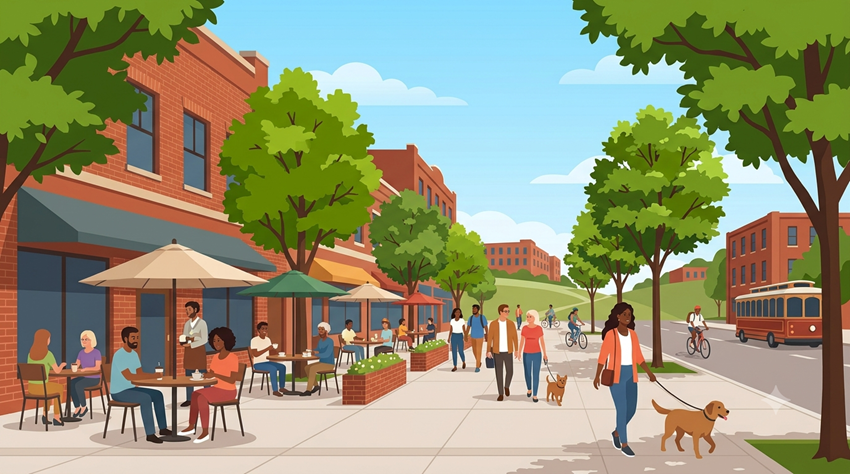

Choosing a neighborhood can shape how a move feels long after the boxes are unpacked. For people who value short errands, local cafés, parks, sidewalks, and a stronger connection to daily life, a walkable neighbourhood can offer a different rhythm from a car-first routine. OKC has several districts where those qualities are more noticeable, while citywide infrastructure projects continue to improve pedestrian connections.
The simplest way to understand what is a walkable neighbourhood is to look beyond the distance between homes and businesses. A useful area lets residents reach several everyday needs without automatically getting behind the wheel.
A strong walkable neighbourhood typically combines connected sidewalks, nearby shops, restaurants, parks, schools, services, and some form of transportation choice. The experience also depends on street design, crossings, lighting, shade, traffic levels, and whether destinations are close enough to make walking practical.
Walkability is the relationship between homes, destinations, public spaces, and connecting routes.
Walk Score currently gives the city an average score of about 34, describing it as car-dependent, while several individual neighborhoods score substantially higher.
A property may look close to a restaurant on a map, yet a difficult crossing, missing sidewalk, or busy arterial can change the practical experience. That makes an in-person neighborhood visit especially useful before choosing a home.
The city is investing in pedestrian infrastructure. Its 2024 bikewalkokc update identifies pedestrian priority areas, while MAPS 4 includes $96.5 million for sidewalks, bike lanes, trails, and streetlights.
Paseo is one of the strongest places to start a neighborhood search. Walk Score lists it as the city’s most walkable neighborhood, with a score of 86. Its compact arts-oriented setting makes it appealing to residents who enjoy local businesses and a neighborhood atmosphere.
The key attraction is the mix of destinations and the area’s recognizable identity. Walk the streets at different times to see whether the pace matches your lifestyle.
Corridor South also ranks highly in Walk Score’s neighborhood data, with a score of 83. Its position on the list makes it worth considering for people who want more daily destinations within a reasonable walking range.
When touring a walkable neighbourhood, examine the spaces between destinations. Check sidewalk continuity, intersections, shade, traffic speed, and comfort after dark.
Mesta Park is another established option. Walk Score gives the neighborhood a score of 82, and a representative Mesta Park location scores 81. The area also includes nearby parks, adding recreational space to the everyday environment.
A walkable neighbourhood can make morning walks or casual errands easier when parks, shops, and services fit regular routines.
Downtown offers a different version of walkability, centered on employment, entertainment, public spaces, restaurants, and transit connections. A representative downtown location has a Walk Score of 84, while ZIP code 73104 scores 64.
Bricktown is part of this broader pedestrian-oriented core. City design guidance requires sidewalks along many development frontages and establishes pedestrian-oriented standards for the district. Individual blocks can still vary.
Walkability scores are useful for comparing a walkable neighbourhood with other areas, but they should not replace a real neighborhood visit. A walkable neighbourhood should work for your actual routine, not merely perform well on a rating system.
Start with your five most common weekly trips, such as groceries, work, school, fitness, dining, or recreation. Then check whether they are genuinely accessible on foot.
Look for walkable neighborhood amenities such as grocery stores, cafés, parks, libraries, restaurants, schools, clinics, and everyday services. The more useful destinations available nearby, the more likely walking becomes a realistic part of your routine.
Check crossings, curb ramps, sidewalk width, lighting, traffic speed, shade, and obstacles. A slightly longer comfortable route can be more useful than a stressful shortcut.
Walkability does not mean giving up a car; it provides more choices. Check bus stops, bike routes, trails, and connections to major employment centers.
The city’s current planning work reinforces this direction. The Classen Corridor Transit-Oriented Development Plan focuses on housing, transportation choices, safety, and walkability along a major corridor that includes Midtown, the Asian District, Paseo, Uptown 23rd, and surrounding neighborhoods.
Before choosing a home, create a simple neighborhood scorecard for convenience, pedestrian comfort, parks, transit, commute, housing costs, noise, and atmosphere.
Then test routes yourself. Walk from a potential home to a coffee shop, park, grocery option, or transit stop. A walkable neighbourhood can feel different from its online profile.
It is also worth visiting during more than one daypart. Morning conditions can reveal commuter traffic, while evenings show lighting, activity levels, and noise. Weekend visits can reveal a different rhythm.
A neighborhood search is only one part of relocating. Your timeline, budget, work schedule, and preferred neighborhood should influence one another.
For a broader relocation plan, use a moving to Tulsa Oklahoma guide as a useful example of the kind of local research worth doing before committing to a new area.
For households weighing a broader relocation, this resource on moving for better future in Oklahoma adds useful context for thinking through the state as a destination.
Once the neighborhood is shortlisted, logistics become easier to organize. When comparing long distance moving companies, review service areas, estimates, insurance terms, and delivery windows.
Comparing best interstate moving companies can help you build a practical moving plan without losing sight of the lifestyle you are trying to create.
Seasonality can matter, too. Oklahoma weather can affect moving-day comfort, so review your options around a summer or winter move before locking in a date.
Use this moving to another city checklist during your neighborhood search:

The goal is a place that fits the way you live.
Neighborhood conditions can change, so infrastructure plans deserve attention during a home search. The city’s MAPS 4 program includes sidewalk phases, bike lanes, bus-stop improvements, trails, parks, and neighborhood connectivity projects extending into future years.
The Classen Corridor plan is another example of how planning can influence future neighborhood character. The city describes transit-oriented development as an approach that creates walkable, mixed-use neighborhoods around reliable transit.
Planned improvements do not guarantee a transformed block, but buyers and renters can consider current conditions alongside documented projects.
A walkable neighbourhood can also support a stronger sense of place. When residents can comfortably walk to a café, park, local shop, or community space, everyday errands can become opportunities to interact with the surrounding area.
The right neighborhood match depends on what you want your days to look like. A young professional may prioritize restaurants, transit, and nightlife. A family may care more about parks, schools, and safe crossings. Someone working from home may value cafés, green space, and nearby errands.
Use walkability as one part of the decision. A walkable neighbourhood with a long commute may not fit your routine, while a slightly less dense area may work well when other priorities are more important.
The same principle applies to housing tours. Inspect the surrounding blocks and test routes you would actually use. Notice what you hear, see, and encounter.
For more detailed research, these tips on how to find the right neighborhood can help turn a general preference into a practical shortlist.
Finding a walkable neighbourhood in Oklahoma City is less about chasing a single score and more about understanding how a neighborhood functions day to day. Paseo, Corridor South, Mesta Park, and the downtown core offer different examples of pedestrian-friendly living, while ongoing public investment is expanding the conversation around sidewalks, transit, trails, and connected streets.
Match those features to your routine. Walk the blocks, test regular trips, and study infrastructure before deciding. A neighborhood that fits your everyday habits can make the entire moving process feel more purposeful.
It is an area where everyday destinations can be reached comfortably on foot through connected streets, sidewalks, crossings, and nearby services.
Walk Score currently lists Paseo, Corridor South, and Mesta Park among the city’s highest-scoring neighborhoods.
Some downtown locations are highly walkable, although conditions vary by block and should be checked during an in-person visit.
Not necessarily; walkability provides more transportation choices, while many residents may still use a car for longer trips.
Test your regular routes and inspect sidewalks, crossings, lighting, traffic, shade, parks, services, transit, and noise at different times.
