
Moving Containers
Recommendation
Moving Container Reviews
Recommendation
Truck Rentals Reviews
Storage Recommendations
Storage Review
Junk Removal Recommendations
Junk Removal Reviews
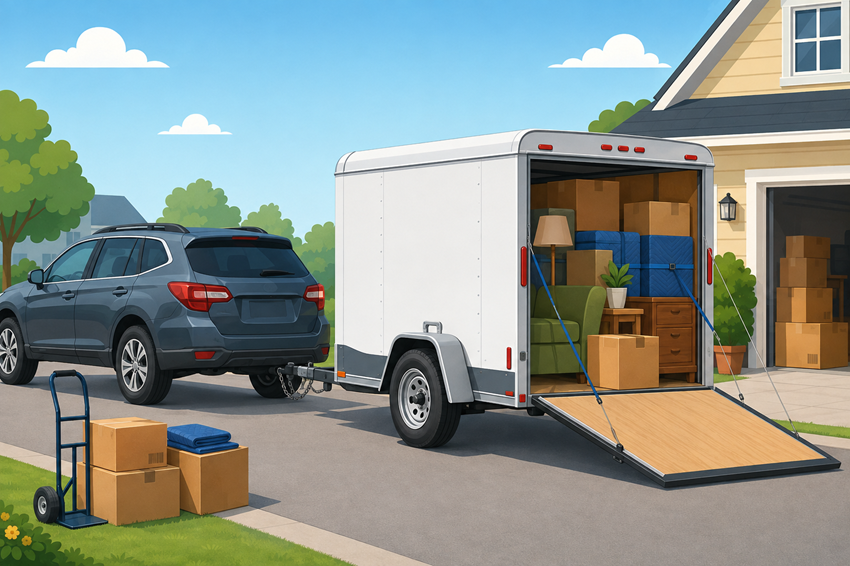

Moving furniture, boxes, appliances, and other household belongings does not always require the expense of full-service movers. A budget trailer rental offers an affordable and flexible way to get extra hauling space while keeping control of the loading, driving, and unloading process. For DIY movers, it can be a practical option for managing transportation costs without sacrificing convenience.
The original guide covered the basic benefits of renting a trailer, including flexibility, cost savings, trailer sizes, rental duration, and booking considerations. This updated version goes further by explaining how to choose the right trailer, estimate your total moving costs, prepare your vehicle, and avoid common rental mistakes.
A budget trailer rental allows you to rent a trailer for transporting personal belongings rather than hiring a company to handle the entire move. The trailer is attached to a compatible vehicle, loaded with your possessions, and driven to your destination.
This approach is particularly useful for smaller household moves, apartment relocations, furniture transportation, DIY moves, and situations where you already have a suitable tow vehicle.
Instead of paying for labor, transportation, and other services bundled into a full-service move, you take responsibility for the parts of the process you can manage yourself.
That control can make a budget trailer rental an attractive option for people who want to keep moving expenses predictable while maintaining flexibility.
The biggest advantage of renting a trailer is the balance between capacity and control. You can transport more belongings than your vehicle can hold without committing to a large moving truck.
For the right type of move, a trailer can cost less than hiring professional movers. You are primarily paying for the rental equipment and related expenses rather than a complete moving service.
However, the cheapest advertised rental is not necessarily the cheapest overall option. Fuel, mileage, insurance, tolls, supplies, and optional equipment can affect your final bill.
If you are comparing several options, our guide to the budget rental truck guide can also help you understand the broader costs associated with DIY transportation.
A budget trailer rental gives you greater control over your moving schedule. You can decide when to load, when to leave, and how to organize the unloading process.
This flexibility can be especially helpful when your move does not fit neatly into a single day or when you need to coordinate your move around work, school, or a lease-end date.
A trailer can make sense when a full-size moving truck would provide more space than you actually need. For example, someone moving from a one-bedroom apartment may only need additional cargo capacity rather than an entire truck.
At the same time, larger households should carefully estimate their belongings before choosing this option.
Selecting the right trailer is one of the most important decisions in a budget trailer rental. Too small, and you may need multiple trips. Too large, and you may spend more money than necessary.
Start by creating a rough inventory of everything you plan to transport. Separate large furniture, appliances, boxes, outdoor equipment, and fragile items.
Think about volume rather than simply counting boxes. A few large pieces of furniture can require considerably more space than dozens of small cartons.
Measure unusually large items such as sofas, beds, wardrobes, desks, and appliances before reserving a trailer.
You should also consider how the trailer will be loaded. Empty spaces around large items can quickly reduce usable capacity.
Before booking, verify that your vehicle is approved to tow the selected trailer. Check the vehicle manufacturer’s towing specifications and compare them with the trailer’s requirements.
Do not assume that a vehicle can tow a trailer simply because the trailer appears lightweight.
Weight limits, hitch requirements, braking systems, tongue weight, and other specifications can all affect towing suitability.
For additional guidance, read about towing with a budget rental truck before making arrangements.
The final price of a budget trailer rental depends on several factors rather than one advertised daily rate.
Rental duration, trailer size, pickup location, mileage policies, seasonal demand, insurance, and optional equipment can all influence the total.
When comparing quotes, ask for the complete estimated cost. Look beyond the base rental price and check for:
This is particularly important when researching budget trailer rental prices, because two apparently similar offers can have very different final totals.
A budget trailer rental one way can be useful for long-distance moves when returning the trailer to the original location would be inconvenient.
One-way availability varies by location and inventory, so confirm the drop-off arrangement before booking. A one-way rental may also have different pricing or restrictions than a round-trip rental.
If your move crosses state lines, it is worth comparing your trailer option with professional services and the best interstate moving companies before making a final decision.
Searching for budget trailer rental near me is a good starting point, but proximity should not be the only factor you consider.
Compare nearby pickup locations based on availability, trailer size, rental terms, mileage allowances, and drop-off options.
A location that is slightly farther away may offer a trailer that better matches your needs or provide more convenient return arrangements.
You should also reserve early if your moving date falls during a busy period. Rental inventory can become limited around weekends, holidays, and common lease-turnover dates.
A successful budget trailer rental is not simply about finding the lowest initial price. It is about reducing the total cost of the move.
Booking ahead gives you more time to compare trailer types and rental terms. It also reduces the risk of accepting a more expensive or unsuitable option because your preferred equipment is unavailable.
Use sturdy boxes and pack them consistently. Place heavier items lower and distribute weight evenly throughout the trailer.
Avoid leaving large gaps between boxes when possible, but do not overload the trailer beyond its rated capacity.
Depending on the rental arrangement, useful moving equipment may include furniture pads, straps, a hand truck, ramps, and protective wrapping.
Before purchasing or renting accessories separately, check what is included with your reservation.
For additional planning ideas, review these budget trailer rental tips for easy moving before moving day.
Good loading technique protects both your belongings and your vehicle.
Start with heavy furniture and sturdy boxes. Keep the load balanced from side to side and position heavier items low whenever possible.
Use appropriate tie-downs to prevent furniture and boxes from shifting during transit. Fragile items should be protected with suitable padding and positioned away from areas where they could be crushed.
Do not exceed the trailer’s weight capacity simply because there appears to be additional physical space.
Before leaving, inspect the hitch connection, safety chains, lights, tires, and load security.
Even a budget trailer rental can become expensive when small mistakes lead to delays, damage, or unexpected charges.
The lowest advertised rate may not represent the best deal. Always compare the complete cost and rental conditions.
Never guess whether your vehicle can safely tow the trailer. Confirm the specifications before making a reservation.
A trailer that looks large enough when empty can fill quickly once furniture and boxes are loaded. Create an inventory before choosing the size.
Last-minute reservations can limit your options and create unnecessary stress. Give yourself enough time to inspect the trailer and prepare your vehicle.
Know exactly where, when, and how the trailer must be returned. If the rental involves a different drop-off location, confirm the arrangement in writing.
There is no single answer because the best option depends on your budget, distance, belongings, schedule, and comfort with driving and loading.
A budget trailer rental can be a strong choice for people who already have a suitable vehicle and want to handle most of the move themselves.
Professional movers may be more practical if you have heavy furniture, limited time, mobility concerns, a complicated long-distance move, or a large household.
You can also consider a hybrid approach. For example, you might rent the trailer yourself while paying local labor for loading and unloading.
Students and renters with smaller loads may also benefit from combining transportation with flexible storage. See these best moving & storage solutions for college students for additional ideas.
The ideal booking time depends on the season, location, and trailer availability, but earlier is generally better.
Once you know your moving date, determine the trailer size, verify your vehicle’s towing capability, compare rental terms, and reserve the equipment.
A few extra days of preparation can also give you time to gather packing materials, organize your belongings, and plan your driving route.
Before leaving the rental location, review your agreement and inspect the trailer.
Confirm the following:
Taking a few minutes to check these details can prevent problems later in the trip.
A budget trailer rental can be an affordable and flexible solution when you have the right vehicle, a manageable load, and the confidence to handle the move yourself.
The key is to look beyond the advertised rental rate. Compare the complete cost, choose a trailer that matches your belongings, verify towing requirements, secure your load properly, and understand the rental agreement before you leave.
For smaller moves and DIY relocations, the right trailer can give you useful cargo space without the expense and scheduling constraints of a full-service moving company.
Yes, it can be cheaper for smaller DIY moves when you already have a suitable tow vehicle.
No, the vehicle must meet the trailer’s towing, hitch, weight, and equipment requirements.
Some rental providers offer one-way options, but availability and terms vary by location.
Check trailer size, towing capacity, rental duration, total costs, insurance, mileage rules, and return requirements.
Book early, compare complete quotes, choose the correct trailer size, and avoid unnecessary add-on fees.
