
Moving Containers
Recommendation
Moving Container Reviews
Recommendation
Truck Rentals Reviews
Storage Recommendations
Storage Review
Junk Removal Recommendations
Junk Removal Reviews
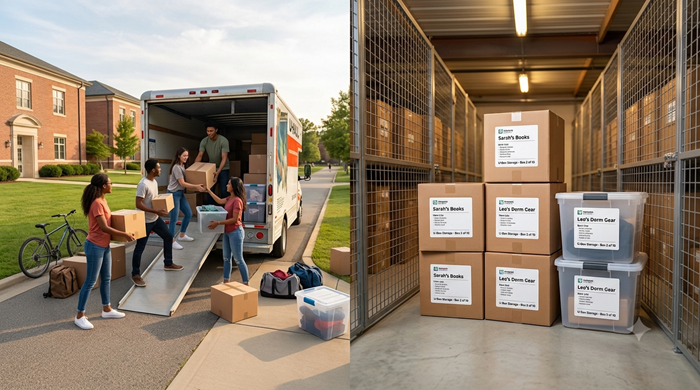

Moving to college, returning home for summer, studying abroad, or relocating after graduation can make even a small amount of belongings feel like a major logistical challenge. Students often have limited budgets, changing schedules, small living spaces, and short windows between semesters. The right college students storage strategy can make these transitions easier while reducing unnecessary transportation costs and clutter.
This updated guide builds on the original WowMover article and expands it with practical options for transportation, temporary storage, containers, professional movers, and semester-to-semester planning.
College moves are different from traditional household relocations. A student may move only a few boxes into a dorm, relocate an apartment across town, or transport belongings across several states.
That flexibility makes college students storage especially useful. Instead of transporting everything every time, students can separate everyday essentials from seasonal and rarely used belongings.
For example, winter clothing, textbooks, small furniture, appliances, and decorations may not need to travel home during every break. Keeping those items securely stored can make move-out and move-in considerably simpler.
Another advantage is cost control. Students can compare transportation and storage independently rather than paying for a large moving package that includes services they do not need.
The best solution depends on how much you own, how far you are traveling, and how much work you want to handle yourself.
A professional college moving company can handle loading, transportation, unloading, and sometimes packing. This option works well for students with furniture or for families helping with a long-distance relocation.
If you are moving across state lines, comparing the best interstate moving companies can help you understand differences in pricing, services, and coverage.
Full-service moving is usually more expensive than a DIY move, but it can save significant time and physical effort.
Labor-only movers are another practical option. You provide the vehicle or container while movers handle loading and unloading.
This can be particularly useful when a student has already arranged college students storage through a local facility or container provider but needs help moving heavy furniture.
Renting a trailer or truck can make sense when a student has a small load and access to a driver. Sharing transportation with roommates can further reduce the cost.
This approach requires more planning because the student is generally responsible for packing, loading, driving, unloading, and returning the vehicle.
Not every move requires the same level of assistance. Before booking, compare different college moving services according to your actual needs.
A short campus move may only require labor. A cross-country relocation could justify transportation and loading assistance. A student leaving for an internship may need temporary storage rather than a traditional moving service.
The goal is to pay for the help that solves your specific problem rather than automatically selecting the most comprehensive package.
Semester breaks create one of the biggest challenges for students who live far from home. Taking everything back can be expensive, inconvenient, and time-consuming.
This is where college students storage becomes valuable. A student can keep non-essential belongings near campus and travel home with only a small personal bag.
A self-storage unit is suitable when you want a dedicated space for boxes, furniture, clothing, and other belongings.
Look for flexible rental periods, convenient access, appropriate security, and a location that is practical for your campus schedule.
Climate-controlled storage can also be worth considering for sensitive items such as electronics, documents, musical instruments, and certain furniture.
For students without access to a vehicle, storage and moving pods can offer a convenient alternative. A container provider typically delivers a container, allowing you to load your belongings before it is transported or placed into storage.
The major advantage is convenience. You do not necessarily need to drive a rental truck across the country yourself.
Students should confirm container dimensions, delivery restrictions, pickup schedules, storage fees, and access policies before committing.
With storage and moving containers, transportation and storage can be combined into one process. Traditional self-storage generally requires you to arrange transportation to and from the facility.
Neither option is automatically better. The right choice depends on whether convenience, accessibility, price, or flexibility is your highest priority.
Summer is one of the most common times students need temporary storage. Carrying an entire dorm room home may not be practical, particularly when home is several hours or states away.
A well-planned college students storage solution lets students leave bulky belongings near campus and return to them when the next academic year begins.
Start by creating three categories: items you will take home, items you will store, and items you will donate or sell.
This simple sorting process can reduce both storage requirements and transportation costs.
College budgets are tight, so controlling moving expenses matters.
First, compare several quotes rather than accepting the first price. Ask whether the estimate includes fuel, labor, stairs, long carries, storage, packing materials, and other potential charges.
Second, avoid moving at the last possible moment. Semester-end demand can make availability tighter and prices higher.
Third, share transportation when practical. Roommates or friends moving to the same area may be able to split a truck, trailer, or container.
Finally, reduce the amount you need to move. Every box that gets donated or sold is one less item to transport or store.
There are situations where storing belongings makes more sense than transporting them.
If you are studying abroad for a semester, returning home for a few months, completing an internship in another city, or moving temporarily between housing arrangements, transporting everything twice can become unnecessarily expensive.
In these situations, college students storage can act as a bridge between two housing arrangements.
The same principle applies to students who live in furnished apartments. There is little reason to transport items that will not be needed in the next location.
If your relocation crosses state lines, look for a state college moving company with experience handling long-distance student moves.
Before booking, verify the company’s service area, estimate process, insurance or valuation options, cancellation terms, delivery expectations, and storage capabilities.
Ask for a written estimate and make sure you understand what is included. A low initial quote may not remain the cheapest option if important services are added later.
Searching for a college moving company near me can produce plenty of options, but proximity should not be the only deciding factor.
Look at the company’s experience, reviews, service options, pricing structure, and ability to accommodate your moving date.
For local moves, ask whether the company offers hourly labor. For long-distance moves, ask about delivery windows and storage options.
Students who want help with lifting, loading, unloading, or local relocation can also consider college hunks moving services.
The important point is to compare the actual services included rather than choosing a provider based only on brand recognition.
If you only need help carrying boxes from a dorm to a vehicle, paying for a complete moving package may not be necessary.
Good packing can reduce both moving time and storage space.
Use sturdy boxes of similar sizes where possible. Label each box by room and contents, and keep important documents, medications, electronics, and valuables separate.
Avoid packing items simply because you already own them. College housing is usually limited, so unnecessary belongings can quickly become expensive clutter.
Students moving into a dorm can also review these college moving tips before choosing what to bring.
For first-time dorm residents, planning ahead is especially important. These smart dorm room packing tips for college move-in can help create a more organized arrival.
The best items for storage and moving are generally things you will need later but do not need immediately.
Seasonal clothing, extra bedding, books, small furniture, kitchen equipment, decorations, and sports gear can often be stored during temporary transitions.
Avoid storing irreplaceable documents, valuables, or items that are sensitive to environmental conditions unless the facility specifically provides suitable protection.
Create an inventory before placing everything into storage. A simple list with box numbers can make the eventual retrieval process much easier.
Research movers, storage facilities, containers, and truck rentals. Request estimates and compare the services included in each option.
Start decluttering and packing non-essential belongings. Confirm your moving or storage reservation and check campus move-out requirements.
Pack daily-use items last, label everything clearly, and separate important documents and valuables.
Keep your inventory accessible, photograph valuable items before transportation, and confirm pickup or delivery details with the provider.
Check boxes against your inventory and report any problems promptly. If you are using college students storage, record exactly where your most important belongings are located.
The biggest mistake students make is treating storage as a place to put everything they do not want to deal with.
Instead, use college students storage strategically.
Group similar items together, use stackable containers, label every box, and keep an inventory on your phone or computer. Place frequently needed belongings where they are easiest to access.
If several roommates need storage, sharing a properly sized solution can also reduce individual costs.
College relocation does not have to mean moving every possession every semester. With thoughtful planning, students can combine transportation, temporary storage, and professional assistance according to their circumstances.
The most effective college students storage strategy starts by deciding what truly needs to travel and what can remain safely stored.
Whether you are moving into your first dorm, returning home for summer, transferring campuses, studying abroad, or beginning life after graduation, choosing the right solution can save time, money, and unnecessary stress.
The best option depends on budget, access needs, storage duration, and the amount of belongings being stored.
Yes, moving containers can work well for students who want transportation and temporary storage combined.
Students should ideally compare and reserve moving services several weeks before busy semester-end periods.
Seasonal clothing, furniture, books, decorations, and other non-essential belongings are common items to store.
Students can save by decluttering, comparing quotes, sharing transportation, moving during less busy periods, and selecting only the services they need.
