
Moving Containers
Recommendation
Moving Container Reviews
Recommendation
Truck Rentals Reviews
Storage Recommendations
Storage Review
Junk Removal Recommendations
Junk Removal Reviews
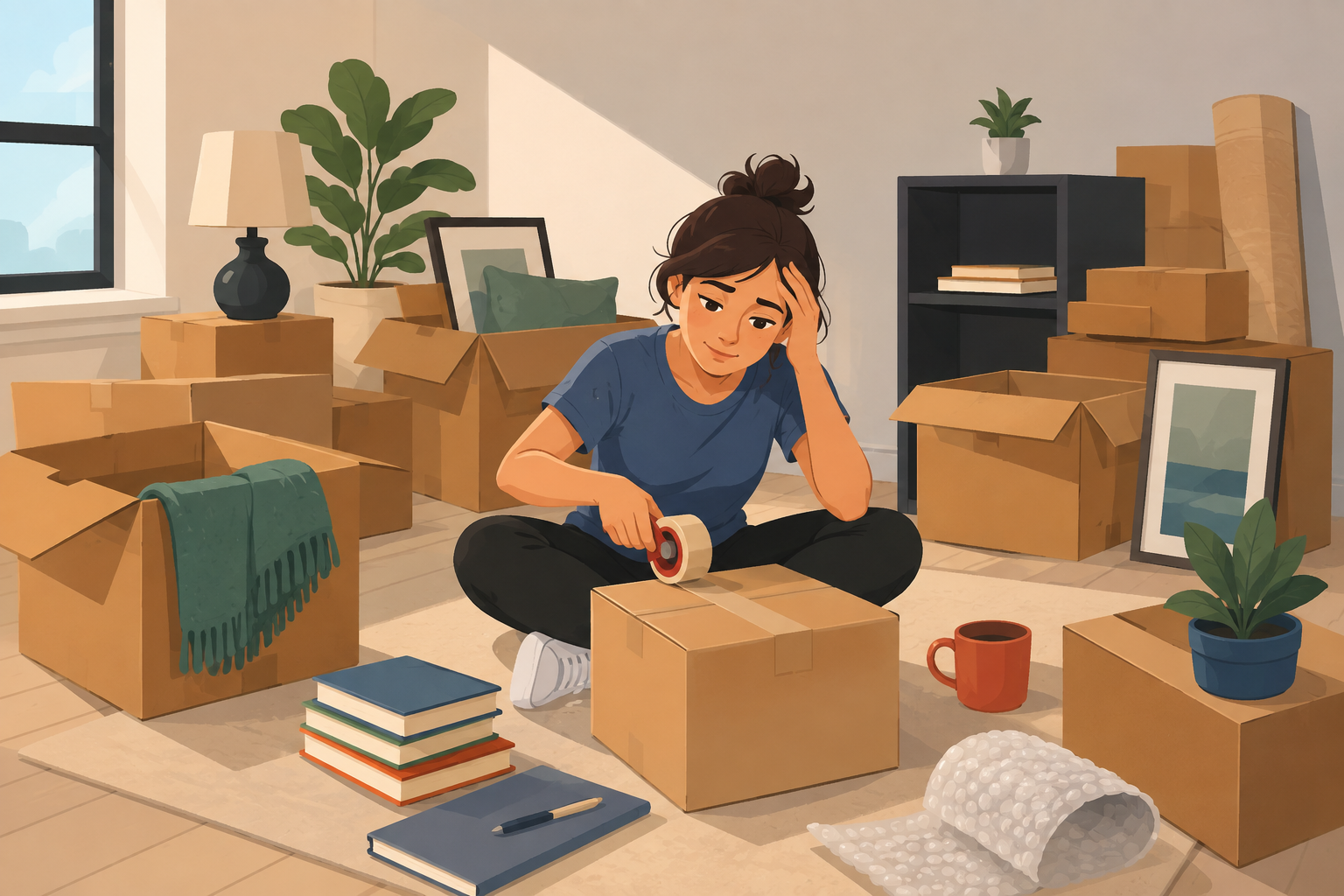

Packing alone is entirely achievable — but only if you treat it as a project with structure, not a task you improvise on moving day. The key difference between a successful solo pack and a chaotic one is a system built before the first box is taped shut.
Packing alone removes the natural quality control that comes from working with another person. There is no one to hold the box steady, remind you what still needs wrapping, or catch the fragile item you almost tossed in loose. What this means in practice is that solo packing requires more planning upfront to compensate for what you lose in real-time support.
Improper packing is widely cited as one of the most common causes of damaged goods during a move — and the risk increases when one person is managing both the physical work and the decision-making simultaneously.
The mental load is also underestimated. You are constantly switching between physical tasks and organizational ones. Should this go to storage? Is this box too heavy? Did you already pack the scissors you need right now? That switching wears you down. Without structure, it leads to decision fatigue — and decision fatigue leads to shortcuts that cost you later.
A realistic packing timeline is the single most important thing you can create before touching a single box. Without one, the last 48 hours before your move become a genuine emergency.
For a standard two- or three-bedroom home, most moving advisors recommend starting packing at least four to six weeks before your move date. Here is how to distribute the work:
Five to six weeks out:
Three to four weeks out:
One to two weeks out:
Final two to three days:
If you are unsure what counts as a true essential, the moving day essentials checklist breaks it down item by item.
This phased approach means you are never overwhelmed by the full scope of the job at once. Each session has a defined scope, which is critical when you are working without a partner to share the cognitive burden.
Buying the wrong supplies is a common solo-packing mistake, because there is no one to course-correct you at the hardware store. Overspending on boxes and undersupplying yourself with protective materials is the typical error.
Here is what you genuinely need for a two-bedroom home:
| Supply | Quantity (2-bed home) | Best Source |
|---|---|---|
| Small boxes (1.5 cu ft) | 20–30 | Liquor stores, grocery stores |
| Medium boxes (3 cu ft) | 25–35 | U-Haul, Home Depot, online |
| Large boxes (4.5 cu ft) | 10–15 | Moving company or retailer |
| Packing paper (unprinted newsprint) | 10–15 lb bundle (adjust up if you have many fragile items) | Office supply stores |
| Bubble wrap | 50–100 ft roll | Amazon, hardware stores |
| Stretch wrap/plastic film | 2–3 rolls | Moving retailers |
| Packing tape with dispenser | 6–8 rolls | Any hardware store |
| Permanent markers | 4–6 | Dollar store |
| Box cutter | 1–2 | Any hardware store |
A few things worth knowing from experience: liquor store boxes are among the best free boxes available because they tend to be sturdily constructed and sized for heavy loads — many are double-walled, though this varies by box, so inspect them before use. Grocery store produce boxes are not — they are often damp and structurally weak.
Unprinted packing paper is almost always better than newspaper for wrapping dishes and glassware. Newspaper ink can transfer to surfaces and may be difficult to clean off ceramics and light-colored items — a risk that is worth avoiding even if modern inks vary in composition.
For guidance on choosing the right packing boxes for specific items, especially electronics and flat-screen TVs, it pays to know the options before you source materials.
The universal rule of solo packing: pack in reverse order of use. Begin with the rooms you visit least — spare bedrooms, storage closets, basements, garages — and end with the spaces you use every day.
Garage and storage areas are usually the easiest to start with because the decision-making is simpler: most items are clearly seasonal or functional. Work through these first while your energy is highest.
Living rooms come next — books, decorative objects, and media collections can be packed weeks before your move without disrupting your daily life.
Bedrooms can be 80% packed two weeks out. Pack out-of-season clothing and extra linens first, leaving only what you are actively wearing and sleeping on.
Kitchens are the hardest room for solo packers. There are more items, more fragile items, and more decisions about what counts as “still needed.” A practical approach: pack everything except a core set of items — one pot, one pan, two plates, two glasses, basic cutlery — and plan on eating simply or using takeout for the final week.
Bathrooms should be packed last, except for a single bag of daily essentials you keep out until moving morning.
Without someone to hold boxes steady or pass items to you, fragile items require more prep work. Lay bubble wrap or packing paper out flat on a table before you start, so you are wrapping on a stable surface rather than improvising in mid-air.
The standard professional method for dishes: wrap each plate individually in packing paper, stack on edge (never flat), and fill all gaps with crumpled paper so nothing shifts in transit. A box of dishes packed on edge and cushioned correctly will survive a cross-country move in a standard moving truck with no damage.
For more detailed guidance on this specifically, the expert tips for packing fragile items walk through the wrapping techniques professionals use.
Labeling is where solo packers consistently cut corners — and pay for it on the other end. When you are packing alone, you have the advantage of knowing exactly what is in every box, which makes labeling feel unnecessary. That knowledge does not survive the chaos of moving day.
Label every box on at least three sides: top and two faces. Use a consistent system:
The priority numbering system is particularly useful when you are unpacking alone. It removes the need to make decisions on unpacking day when your energy is depleted.
One practical observation: mark at least one box clearly as “DO NOT LOAD LAST” for the items you will need within the first hour at your new home. When working with professional movers, this box stays visible and accessible throughout loading. Without the label, it will inevitably end up behind everything else in the truck.
Working without a partner means working without a witness. This matters particularly when professional movers are involved, because your word against theirs is how damage disputes often resolve — and a written inventory changes that dynamic entirely.
Before a single box leaves your home, photograph every box closed and labeled. For items of real value — electronics, art, instruments — photograph the item itself before packing. According to the Federal Motor Carrier Safety Administration, movers are required to provide a bill of lading for every shipment, and your inventory documents should match that list precisely.
Create a simple spreadsheet or use a notes app: box number, contents, condition at packing. This takes about 20 additional minutes per room and removes enormous ambiguity if anything arrives damaged or missing.
For a complete breakdown of the documentation you should maintain during a move, the guide to moving documents covers what to file and what to keep accessible on moving day.
This is the part of solo packing that no checklist accounts for adequately. Physical packing is exhausting work, and doing it alone means there is no natural rhythm of conversation, task-sharing, or someone to say “let’s take ten minutes.”
A few things that work in practice:
Set session limits, not daily goals. Commit to two-hour packing sessions with defined endpoints rather than “I’ll pack until I finish the kitchen.” Defined endpoints prevent the fatigue spiral where tired decisions create poor packing that you will regret on moving day. For a broader look at how to structure your time across the full move, the moving timeline guide gives week-by-week milestones.
Pack in the morning where possible. Decision-making quality drops significantly in the evening. Choices made about what to keep, donate, or discard are better made when you are rested.
Use audio — a podcast, music, or an audiobook — strategically. Background audio reduces the sense of isolation that makes solo packing feel more draining than it is physically. It also keeps your pace up during repetitive tasks like wrapping dishes.
Eat and hydrate deliberately. It is easy to skip meals when you are working alone and absorbed in the task. Set a phone alarm for lunch. Dehydration and low blood sugar produce the exact mental state — irritable, impatient, poor at decisions — that leads to damaged items and poor packing choices.
Solo packing is appropriate for most standard moves. There are situations where it genuinely is not the right choice, and recognizing them early saves significant money and stress.
If you have any of the following, consider professional packing help for at least those items:
Professional packers are faster than most people expect — a two-person packing crew can typically pack a two-bedroom apartment in three to five hours. The cost is real, but the time and risk trade-off is worth calculating honestly rather than dismissing. The guide to professional packing services covers what to expect and how to vet a company before booking.
Packing time varies considerably by how many items you own and how methodically you work, but a realistic estimate for a two-bedroom home packed alone is 20 to 35 hours of active work spread over several weeks. A three-bedroom home typically requires 35 to 50 hours. Compressing this into a weekend almost always results in poorly packed boxes and items left behind.
Your open first box should contain everything you need for the first 24 hours at your new address: phone charger, medications, one change of clothes, toiletries, basic kitchen supplies (coffee, a cup, a plate), important documents, and any items your pets need. Keep this box with you in your vehicle rather than loading it into the truck.
Packing alone beforehand is manageable with good planning. Moving day itself — actually loading boxes and furniture — is where solo work becomes genuinely risky. Heavy furniture moved without a second person causes a significant proportion of residential moving injuries. Hiring professional movers for the loading and transport, even if you pack everything yourself, is the safer and often more cost-effective choice.
A box inventory log is the most reliable method. Number every box sequentially, then record box number and contents in a spreadsheet or notes app as you pack each one. Color-coded tape by room (one color per room) adds a fast visual sorting layer on top of the written log. This system adds about 10 minutes per room but prevents the common problem of spending an hour searching for something you packed three weeks earlier.
Clothing can typically stay in dresser drawers if the movers are handling the furniture — most professional movers will use stretch wrap to keep the drawers closed during transit. However, heavier items like books, tools, or anything breakable should be removed and packed separately. An overfull drawer adds significant weight that can cause furniture damage and makes the dresser harder to handle safely on stairs and ramps.
Underestimating how long it takes is the most common error, followed closely by leaving kitchen packing too late. In practice, most solo packers find themselves doing a disorganized rush pack of their kitchen the night before the move — which is when glasses break, items get left behind, and boxes end up overweight and mislabeled. Kitchen packing should start at least ten days out, even if you are only packing the items you use infrequently at first.
Packing alone is a completely realistic undertaking for most moves — the people who struggle with it are almost always the ones who started too late, underestimated their volume, or skipped the inventory step. Start earlier than you think you need to, work in defined sessions, and protect your documentation. Those three habits are what separate a smooth solo move from the kind that ends with an emergency call to a moving company the night before.
For a complete picture of what a well-organized move looks like from start to finish, the ultimate moving checklist covers every phase from initial planning through the first 30 days in your new home.
