
Moving Containers
Recommendation
Moving Container Reviews
Recommendation
Truck Rentals Reviews
Storage Recommendations
Storage Review
Junk Removal Recommendations
Junk Removal Reviews
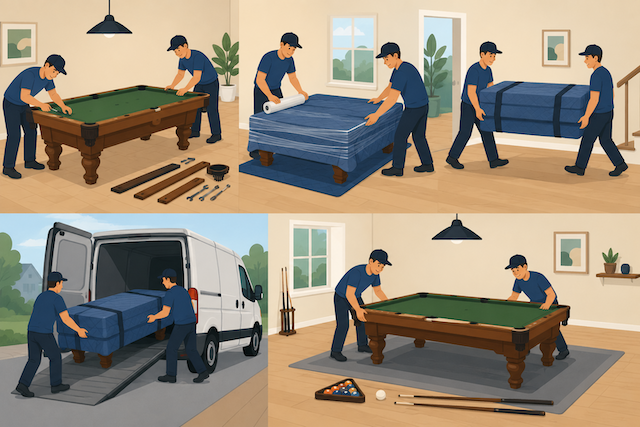

Moving a pool table is not like moving a couch or a dining set. A standard seven-foot table weighs between 700 and 1,000 pounds, and the three-piece slate top alone can tip the scales at over 500 pounds. One wrong tilt, one moment of poor alignment, and you are looking at a cracked slate or a permanently unlevel playing surface.
The good news is, you can move a pool table successfully with the right plan, the right tools, and the right help. Whether you are relocating across town or across state lines, this guide walks you through every step, from disassembly to reassembly, so your table arrives in the same condition it left. Pool tables rank among the most difficult things to move in any household, which is why proper preparation matters so much.
Plenty of people attempt a DIY pool table move to save money. And plenty of them end up paying more in repairs than they would have paid a professional.
The slate is the biggest concern. It is a natural stone that can crack if the table is tilted too far or if the pieces are not handled evenly. The frame is also susceptible to twisting, which ruins the playing surface even if the slate survives. And the felt is delicate enough that a single snag can leave you with a tear that requires a full refelt.
If you have at least four strong adults, the right equipment, and a willingness to follow every step carefully, a DIY move is possible for a standard table. But for antique tables, high-end models, or any table with a one-piece slate, professional movers are strongly recommended.
For example, moving a piano is similar in complexity to moving a pool table. Both require disassembly, specialized handling, and careful transportation. If you are considering the DIY route, our dos and don’ts when moving a piano guide covers the same kind of precautions that apply here.
Before you touch the table, gather everything you need. Running to the hardware store halfway through the disassembly is the fastest way to make a mistake.
Tools and supplies checklist:
You also need a pickup truck, a large van, or a moving truck with a flat, clean cargo area. A standard SUV will not work. The slate pieces alone are too heavy and too wide for most passenger vehicles.
If you are renting a truck, make sure it has a low load height and a ramp rated for heavy items. Penske and Budget both offer trucks with loading ramps that can handle the weight.
You cannot move a pool table fully assembled. It simply will not fit through most doorways, and the risk of damage is far too high. Proper disassembly is the foundation of a successful move.
Start with the pockets. They are usually attached with screws or staples beneath the rail. Remove them carefully and set them aside in a labeled bag. The leather or nylon material is durable but can snag, so handle them gently.
The rails are the wooden sections that surround the playing surface. They contain the rubber cushions that give the table its bounce. Each rail is held on by bolts from underneath the table.
Before removing the rails, mark each one with a piece of tape indicating its position. Rail A, Rail B, Rail C, and Rail D, or left, right, top, and bottom. The rubber cushions have a specific orientation and can wear unevenly over time. Putting a rail back in the wrong spot can affect the ball response.
The felt, or cloth, is stapled to the slate and the rail caps. If you are working with a standard pool table, you can carefully remove the staples and peel the felt off in one piece. This is easier if someone holds the felt taut while you work.
If the felt is old or already showing wear, consider yourself fortunate. You can replace it at your destination without worrying about preserving it. For newer or high-quality felt, take your time and roll it onto a cardboard tube to prevent creasing.
This is the most critical step. Most pool tables use a three-piece slate for weight distribution and easier handling. Each piece weighs roughly 150 to 200 pounds.
The slate pieces are held together with bolts and often glued at the seams with beeswax or a similar compound. Remove the bolts first, then gently tap a putty knife along the seam to break the bond. Do not pry the pieces apart with force. If they resist, check for missed bolts.
Once separated, lift each piece straight up. Never slide one piece against another, as the stone edges can chip. Lean each piece against a padded wall or lay it flat on a blanket.
With the slate removed, the frame is exposed. Remove the legs first, then break down the frame rails. Label every joint and keep the hardware in separate bags. A simple label like Leg Front Left or Frame Long Side saves hours of frustration during reassembly.
With the table fully disassembled, you now have several manageable components: the legs, the frame rails, the slate pieces, the rails with cushions, and the hardware bags.
Wrap each slate piece individually in moving pads and secure the pads with stretch wrap. Then sandwich the pieces between sheets of plywood and secure them with ratchet straps. This prevents the slate from sliding or bumping during transit.
Load the slate pieces flat on the floor of the truck, not on top of other items. The frame and legs can go on top of blankets beside the slate. The felt should be rolled and placed in a clean, dry spot away from tools or heavy objects.
Secure everything inside the truck so nothing shifts when you turn or brake. A pool table component sliding into the side of the truck can do real damage.
Our guide on how to prep disassembled furniture for moving covers additional techniques for keeping furniture parts organized and protected during transit.
Reassembly is essentially the reverse of disassembly, but with a few extra considerations.
The single most important part of reassembly is leveling the slate. Even a minor slope will send the cue ball drifting off line.
Set the frame in its final position first. Level the frame itself using the adjustable feet or shims. Then place the slate pieces and level each one independently, using shims between the slate and the frame as needed. A machinist’s level gives the most accurate reading, but a high-quality carpenter’s level can work if you check it in multiple directions.
Once all three pieces are level individually, bolt them together and check the seams. The transition between pieces should be smooth with no lip.
If you removed the felt in one piece, lay it back over the slate and staple it in place starting from the center of each side and working outward. Keep the felt stretched tight but not distorted. If you are installing new felt, this is the time to do it.
Bolt the rails back in their original positions. Reinstall the pockets. Check that the ball return system (if your table has one) is clear and functioning before calling the job done.
A full reassembly with proper leveling takes most people two to three hours. Rushing this step is the fastest way to end up with a table that nobody wants to play on.
There is no shame in hiring movers for a pool table. In fact, many moving companies list pool tables as an item they handle regularly. Unlike certain hazardous materials that professional movers refuse to transport, pool tables are accepted by most full-service moving companies without issue.
If your table has a one-piece slate, you absolutely need professional help. One-piece slates can weigh over 500 pounds and require a hydraulic lift and multiple strong movers to handle safely.
The cost to hire professional pool table movers varies widely. Local moves typically run between $250 and $500 for disassembly, transport, and reassembly. Long-distance moves add to that based on weight and distance. Considering that a cracked slate can cost $400 or more to replace and refelting runs $200 to $500, professional moving often pays for itself in peace of mind alone.
If you are already planning a larger relocation, bundling the pool table move with your household goods can save money. Our guide on the best long-distance moving companies lists movers that handle specialty items like pool tables.
It also helps to read individual mover reviews before booking. For example, our Two Men and a Truck review covers how that company approaches heavy-item moves, which can give you a sense of what to expect from a professional crew.
And if you are trying to understand how moving quotes work, especially for items with specific weight and handling requirements, our breakdown of binding vs non-binding moving estimates explains what each type means for your final cost.
Mistakes happen most often when people underestimate the complexity of the job. Here are the ones we see most frequently.
Not labeling anything. This is the number one mistake. Without labels, you will spend hours figuring out which bolt goes where during reassembly.
Forgetting to measure doorways and hallways. Measure the width of every doorway, hallway, and stairwell at both locations. A disassembled pool table still needs to fit through the path you plan to take.
Tilting the slate. Keep slate pieces flat or nearly flat at all times. Tilting them on edge puts uneven pressure on the stone and can cause cracks.
Skipping the leveling step. The table will not play right if you do not level it. Period.
Using the wrong moving pads. Thin blankets offer almost no protection for a 200-pound slab of stone. Use thick moving pads or furniture blankets rated for heavy items.
Sometimes the real question is whether to move the table at all. A cheap, entry-level table may not be worth the cost and effort of professional moving. You might be better off selling it and buying a new one at your destination.
But if you own a quality table with a solid hardwood frame, precision-ground slate, and good cushions, moving it is absolutely worth it. Quality tables cost several thousand dollars new, and a well-executed move preserves the value and playability for years to come.
If you decide to sell, our guide on how to get rid of unwanted items when moving offers practical tips for selling furniture and large items before a move.
Moving a pool table is one of the more challenging tasks in any relocation, but it is entirely doable with the right approach. The keys are thorough disassembly, careful handling of the slate, proper leveling during reassembly, and honest self-assessment of whether you need professional help.
If you take your time, label everything, and never lift more than you can handle safely, your pool table will be ready for its first game in your new home before you know it.
Ready to start planning your move? Get a free moving quote from licensed and insured movers who can handle the heavy lifting.
