
Moving Containers
Recommendation
Moving Container Reviews
Recommendation
Truck Rentals Reviews
Storage Recommendations
Storage Review
Junk Removal Recommendations
Junk Removal Reviews
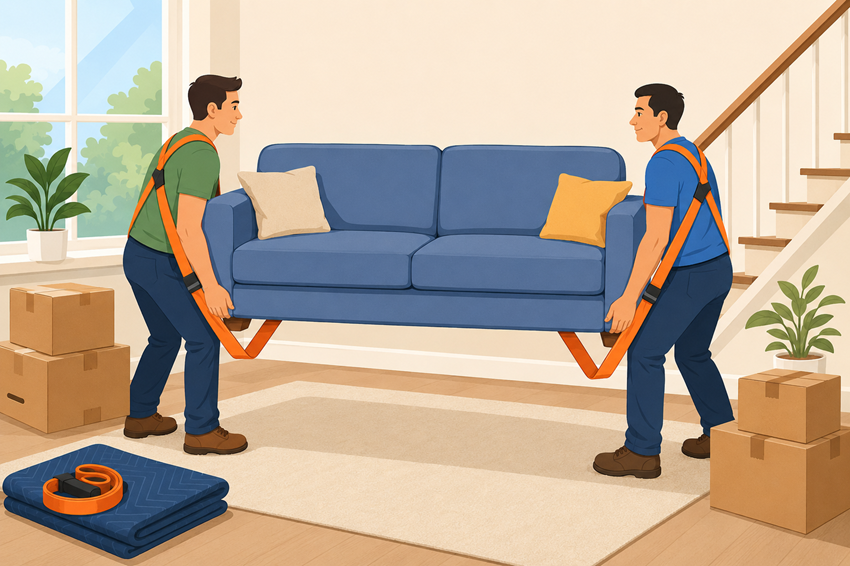

Moving a sofa, dresser, dining table, or other bulky piece can quickly become difficult when you do not have the right technique. Knowing how to use lifting straps can make furniture moving more controlled by helping distribute weight and allowing two people to work together more effectively.
Whether you are preparing for a DIY move or handling a few large pieces before the movers arrive, the right approach matters. This guide explains how to position the straps, coordinate with a partner, navigate stairs, and avoid common mistakes when moving bulky furniture.
Heavy furniture is not always difficult because of its weight alone. Its shape, size, uneven balance, and lack of convenient handholds can make carrying it much harder.
Lifting straps are designed to create better leverage between two people. Instead of relying entirely on arm strength, the straps help transfer more of the load through the body while allowing both movers to maintain a steadier grip and posture.
This can be especially useful when lifting straps moving furniture such as couches, cabinets, desks, and other large household items that are difficult to carry by hand.
They are not a replacement for proper planning, however. Before lifting anything, you still need to assess the item’s weight, dimensions, route, and condition.
Not all moving straps work in exactly the same way. Choosing a suitable design before starting can make the process easier and more controlled.
Forearm-style straps wrap around the forearms and pass beneath the item. They can be useful for rectangular furniture with a stable base and enough clearance for the strap to slide underneath.
This style gives both movers flexibility to adjust their position while carrying the load.
Harness systems use straps that connect around the shoulders or upper body. These are often designed to improve leverage and help distribute the load more evenly.
They can be useful for larger items, but proper adjustment is important before attempting a lift.
The size and shape of the furniture should influence your choice. A heavy dresser may require a different setup than a wide sectional sofa or a tall cabinet.
If you are unsure about sizing, materials, and strap styles, this detailed lifting straps guide can help you understand how different systems support heavy-object transport.
Preparation should begin before the straps ever touch the furniture.
Check for loose drawers, removable shelves, detachable legs, glass panels, and unstable components. Remove anything that could shift or fall during the move.
For larger pieces that can be taken apart, disassembly may make the item easier to transport. Following a process for how to prep disassembled furniture for a smooth move can also help protect individual components during the move.
Once the furniture is prepared, measure the item and inspect the path from its starting point to the moving vehicle or final location.
Using straps properly requires coordination between both people. Do not rush through the setup simply because the furniture appears manageable.
Remove rugs, boxes, cords, and other obstacles before lifting. Check doorways, hallways, corners, and low ceilings.
A clear path reduces the chance that one person will need to stop suddenly while carrying the load.
If stairs are involved, identify where each person will stand and discuss the direction of movement before picking up the furniture.
Place the furniture where both movers can access opposite sides comfortably.
Make sure the item is stable and does not have loose drawers, doors, or removable sections that could shift unexpectedly.
For tall or top-heavy pieces, consider whether the center of gravity will change when the item is tilted.
Place the straps beneath the strongest and most stable part of the furniture.
Avoid positioning them under weak panels, loose trim, or components that could bend under pressure.
When using furniture lifting straps moving large items, make sure both sides of the strap are positioned evenly. An uneven setup can cause the furniture to tilt toward one mover.
Both movers should adjust the straps before lifting. The goal is to create a position where neither person is forced to overreach or bend excessively.
The furniture should remain relatively level when both people take up the tension.
Do not begin carrying if one person is supporting significantly more weight than the other.
One person should take responsibility for giving simple commands such as “ready,” “lift,” “stop,” and “lower.”
Both movers should agree on the plan before starting.
Good communication is particularly important when lifting straps moving heavy items through narrow hallways or around tight corners where visibility may be limited.
Bend your knees, keep your back in a neutral position, and rise gradually together.
Avoid jerking the furniture upward or attempting to catch the load if it begins to shift.
The straps should help improve leverage, but they do not eliminate the need for proper lifting technique.
Take short, controlled steps. Keep the furniture close enough to maintain control without allowing it to swing.
If the load begins to tilt or shift, stop in a safe position and reset rather than trying to correct a major imbalance while walking.
This is especially important when using furniture moving straps on wide or unevenly weighted items.
Stairs introduce additional risks because the load must be controlled at different heights.
The person moving downhill may experience more of the furniture’s weight, while the person moving uphill may have limited visibility. Discuss who will lead and how you will communicate before starting.
For a more detailed explanation of positioning, coordination, and stair movement, review how to use lifting straps safely on stairs.
Never rush a stair move. If the furniture blocks the path completely or either person cannot maintain stable footing, stop and reassess.
Even quality straps can be used incorrectly. Avoid these common problems when moving large household items.
Before fully lifting the item, gradually take up the tension and test whether both movers can control the load.
If the item is significantly heavier than expected, do not force the move.
Inspect the straps for tears, fraying, damaged stitching, or weakened buckles before use.
A damaged strap should not be trusted with a heavy load.
Drawers, doors, shelves, and detachable components can shift while the furniture is being carried.
Remove or secure them before starting.
Different furniture requires different positioning. A poor setup can create an unstable center of gravity or place too much pressure on a weak area.
If you need help comparing strap options, this resource on how to choose the best moving straps for heavy lifting can help you match the equipment to your moving needs.
Lifting straps are generally designed to work with coordinated lifting. Attempting to manage a large piece of furniture alone can increase the risk of losing control.
For major relocations involving many heavy pieces, working with one of the best interstate moving companies may be a more practical option than handling the entire move independently.
Straps can be helpful, but they are not appropriate for every situation.
Extremely heavy safes, fragile antiques, oversized appliances, and unusually shaped furniture may require specialized equipment. Dollies, sliders, appliance carts, or professional crews may offer better control.
The same applies when the moving route includes multiple flights of stairs, sharp turns, slippery surfaces, or limited clearance.
A professional furniture moving company can assess these challenges and use equipment suited to the item and environment.
A successful move is usually the result of preparation rather than strength alone.
Measure furniture and doorways before moving day. Protect corners and floors where necessary, and decide which pieces should be moved first.
Use a spotter when visibility is limited. Take breaks when needed, especially during longer moves.
Most importantly, know when to stop. If the furniture is too heavy, the route is unsafe, or the load cannot be balanced, changing the plan is better than forcing the move.
When using lifting straps moving bulky household items, steady coordination will always be more valuable than trying to move faster.
Learning how to use lifting straps for moving furniture can make large and awkward household items easier to control when the equipment is set up correctly and both movers work together.
Start by choosing suitable straps, preparing the furniture, clearing the route, and agreeing on clear commands. Test the load before committing to the move, lift gradually, and stop whenever the furniture becomes unstable.
With the right preparation, furniture lifting straps moving large pieces can be a practical solution for many household moving tasks. However, when the load, route, or circumstances create unnecessary risk, professional assistance is often the smarter choice.
Yes, lifting straps can be safe when used correctly with a suitable partner, proper technique, and undamaged equipment.
Most heavy furniture lifting strap systems are designed for two people and should not be used alone for large loads.
They work best on stable items with suitable clearance, but awkward, fragile, or extremely heavy pieces may require other equipment.
Yes, but only with proper coordination, secure footing, and a clear understanding of each mover’s position.
Inspect the straps for damage, secure loose furniture parts, clear the route, and test the load before moving.
