
Moving Containers
Recommendation
Moving Container Reviews
Recommendation
Truck Rentals Reviews
Storage Recommendations
Storage Review
Junk Removal Recommendations
Junk Removal Reviews
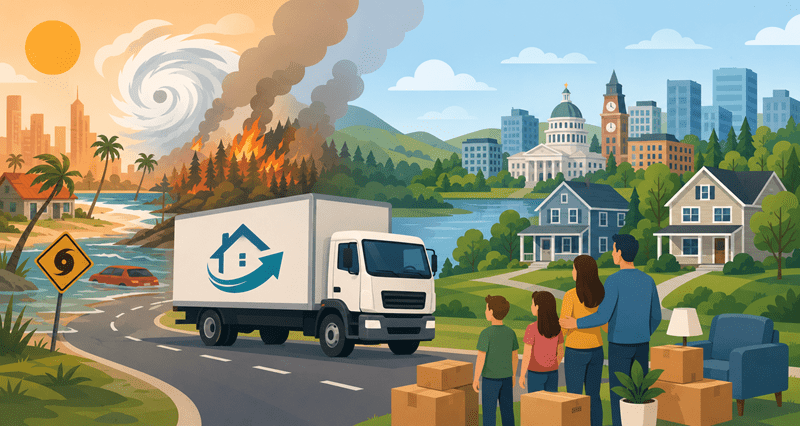

For years, Americans flocked to warm-weather states in search of lower taxes, bigger homes, and year-round sunshine. Cities across Florida, Texas, Arizona, and other fast-growing Sunbelt regions became magnets for relocation. But that trend is beginning to shift in a surprising way.
Today, climate concerns are influencing where people move — and where moving companies are willing to operate profitably. Rising insurance costs, extreme weather events, wildfire exposure, hurricanes, and heat waves are changing the economics of relocation. In response, many households are now leaving high-risk areas behind and heading toward so-called “climate havens.”
This shift is transforming the moving industry. Customers are rethinking destination choices, while movers are adapting routes, pricing, and long-term business strategies around environmental risk.
If you’ve recently searched for a long distance moving company near me, you may have already noticed rising rates, longer scheduling windows, or limited availability for certain regions. There’s a reason for that — and it goes far beyond fuel prices.
A climate haven is a city or region considered more resilient against major climate threats such as hurricanes, flooding, droughts, and wildfires. These locations are increasingly attracting homeowners, renters, and remote workers looking for long-term stability.
Climate havens often share several key traits:
Cities in the Midwest, Northeast, and parts of the Great Lakes region are becoming popular examples. Places like Buffalo, Duluth, Pittsburgh, and Madison are now appearing in relocation conversations more often than many traditional retirement hotspots.
For movers, this means demand patterns are changing rapidly.
The Sunbelt remains attractive in many ways, but insurance companies are increasingly viewing these regions as high-risk zones.
Florida and Gulf Coast states continue to experience stronger hurricanes and rising flood-related claims. Insurance providers have responded by raising premiums, tightening policies, or exiting markets altogether.
Homeowners relocating to these areas are now facing costs they didn’t anticipate during the buying process.
Arizona, Nevada, and parts of California are also dealing with growing wildfire concerns. Entire neighborhoods can become difficult or expensive to insure, which affects home values and relocation demand.
This uncertainty impacts moving companies too. Transport routes, storage facilities, and logistics operations all become more vulnerable.
Extreme heat is another growing issue across southern states. Prolonged heat waves strain electrical grids, damage roads, and increase operational expenses for transportation companies.
Moving trucks traveling across these regions face additional maintenance risks and fuel inefficiencies during peak summer months.
The moving industry is adjusting quickly to this new reality. Relocation companies are no longer evaluating moves based only on distance and labor. Environmental risk has become part of the equation.
Movers now factor weather disruptions into scheduling and pricing. Hurricane seasons, wildfire zones, and flooding risks can delay deliveries and increase liability.
Some carriers are even limiting service availability during peak-risk periods.
Commercial insurance premiums for transportation companies have climbed sharply in high-risk states. Those costs eventually reach customers through higher estimates and seasonal surcharges.
That’s one reason consumers are spending more time researching the best rated long distance moving companies before committing to a relocation partner.
Cities once overlooked by movers are seeing increasing inbound demand. Northern and inland regions now represent growth opportunities for moving companies adapting to climate migration trends.
As relocation patterns evolve, movers are opening new distribution hubs and expanding networks into emerging climate-resilient markets.
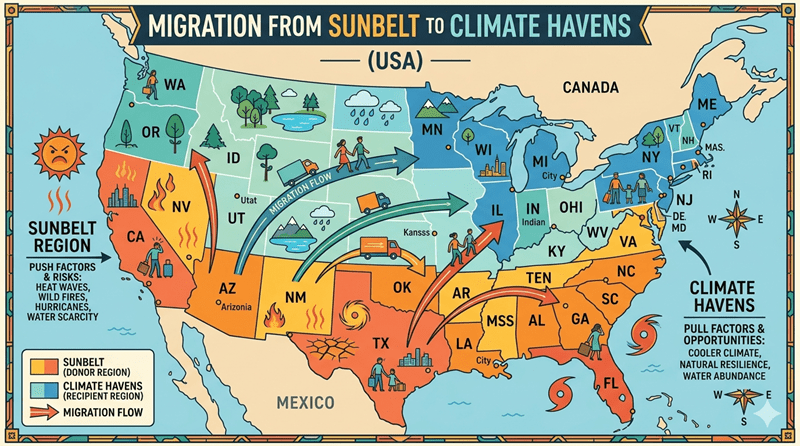
Climate migration isn’t just about fear of disasters. For many households, it’s becoming a financial decision.
Insurance bills in some coastal regions have doubled or tripled in recent years. Combined with higher property taxes and maintenance expenses, the overall affordability equation is changing.
Many families are discovering that the dream of low-cost Sunbelt living no longer matches reality.
The rise of remote work allows more people to prioritize long-term livability over proximity to offices. Workers who once needed to live in expensive or climate-vulnerable cities now have greater flexibility.
That flexibility is fueling migration toward smaller, more stable metro areas.
People are increasingly asking practical questions before moving:
Those concerns are redefining relocation decisions across the country.
Related Post: Why Americans Move So Often: The Real Reasons Behind It
Many consumers focus only on the immediate price of moving. But the true expense of relocation often appears later through insurance, utilities, repairs, and disaster preparedness.
Understanding the real cost of relocating today can help families avoid financial surprises after the move is complete.
In many cases, lower mortgage payments in high-risk regions are offset by long-term ownership costs.
That reality is one reason climate havens are gaining momentum.
As uncertainty grows, many customers want more adaptable relocation solutions.
Some families are delaying permanent housing decisions while exploring new cities temporarily. Others are downsizing before making cross-country moves.
This shift has increased interest in portable storage solutions like pods, hybrid moving services, and partial-load transport options.
Budget-conscious customers are also exploring alternatives like two men and a truck style moving services for smaller or more flexible relocations.
Movers that offer customizable services are better positioned to serve changing consumer behavior.
Several regions are emerging as top relocation destinations because of climate resilience and affordability.
Cities near the Great Lakes are attracting renewed attention due to freshwater access, moderate summers, and lower natural disaster exposure.
Buffalo, Cleveland, Milwaukee, and Duluth have all seen increased relocation interest.
Areas with strong healthcare systems, stable infrastructure, and affordable housing are becoming appealing alternatives to overcrowded Sunbelt metros.
College towns often provide economic stability and quality-of-life benefits without major climate threats.
Secondary Northeastern cities are also benefiting from climate migration trends. Many offer walkable neighborhoods, established public infrastructure, and lower disaster risk.
These areas may continue seeing population growth as climate concerns intensify.
The moving industry is entering a new phase where climate risk directly influences consumer behavior, operational planning, and pricing structures.
Moving companies will likely continue expanding into climate-stable regions while becoming more cautious in disaster-prone markets.
Extreme weather events may create sudden demand spikes, route interruptions, and scheduling challenges.
Customers who plan earlier and remain flexible will have an easier moving experience.
Consumers are becoming more informed about long-term livability, not just short-term affordability.
That means moving decisions are increasingly tied to sustainability, infrastructure, and resilience.
Not every move requires the same approach. Some households need full-service cross-country relocation, while others benefit from storage-assisted or labor-only options.
Understanding different moving services and company types can help customers choose solutions that fit their budget, timeline, and destination risks.
As climate migration continues, flexibility and planning will matter more than ever.
The idea of climate migration once sounded like a distant concept. Today, it’s actively reshaping housing markets, insurance costs, and the moving industry itself.
Long-distance movers are adapting to new patterns as more Americans reconsider where they want to build stable, affordable lives. While the Sunbelt still attracts many newcomers, rising climate-related risks are pushing others toward safer and more sustainable destinations.
For consumers planning a major relocation, the smartest move is no longer just about price or square footage. It’s about choosing a location that can support long-term financial and environmental stability.
As climate havens continue gaining attention, the future of moving may look very different from the trends that defined the past two decades.
A climate haven is a region considered less vulnerable to severe climate-related disasters.
Higher insurance costs and weather-related risks are making some regions more expensive to serve.
Yes, insurance premiums and route disruptions are contributing to higher moving expenses.
Great Lakes cities, Midwestern towns, and parts of the Northeast are seeing growing demand.
Yes, many consumers now prefer adaptable moving and storage solutions during uncertain relocations.
