
Moving Containers
Recommendation
Moving Container Reviews
Recommendation
Truck Rentals Reviews
Storage Recommendations
Storage Review
Junk Removal Recommendations
Junk Removal Reviews
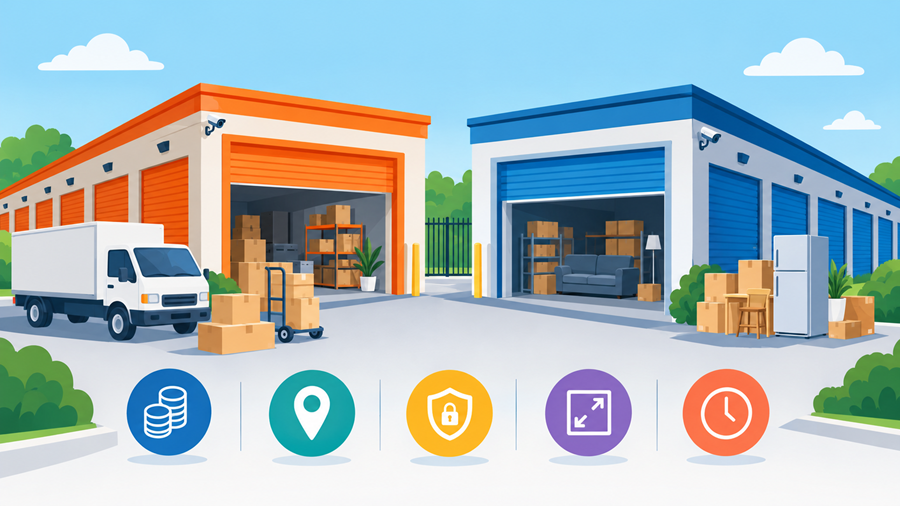

Choosing between Public Storage and CubeSmart comes down to more than monthly rent. Pricing, location, unit sizes, access hours, security features, and lease flexibility all influence which self-storage provider offers better value. Both companies serve customers who need extra space during a move, home renovation, downsizing project, or temporary transition.
This guide compares Public Storage and CubeSmart across costs, convenience, security, customer experience, and storage options. By understanding the differences, you can choose a facility that fits your budget and storage needs without paying for features you may not use.
Public Storage and CubeSmart are established self-storage operators in the United States. Both provide storage units for individuals, families, students, and businesses, but the experience can differ depending on the facility.
Public Storage is a large self-storage company offering units in various sizes for household goods, furniture, seasonal belongings, business inventory, and other personal possessions. Many facilities provide features such as gated entry, surveillance systems, drive-up units, and online rental options.
Its extensive network can make it a practical choice for people relocating, storing furniture during renovations, or looking for additional space close to home.
CubeSmart provides self-storage solutions for residential and commercial customers. Its facilities may offer climate-controlled units, drive-up access, online reservations, moving supplies, and other convenience-focused services.
Availability depends on the individual location. Customers should check the specific facility’s features before reserving a unit rather than assuming every property offers the same amenities.
Price is often the first consideration when comparing these providers. However, the cheapest advertised rate does not always translate into the lowest total cost.
Public Storage rental rates vary according to location, unit dimensions, demand, climate control, and access features. Introductory promotions may reduce the initial cost, but the regular rental rate and any applicable fees should be reviewed before signing an agreement.
Customers should also ask about insurance or protection plans, required locks, administrative charges, and potential rate increases.
CubeSmart uses similar pricing factors. A smaller unit in a less expensive neighborhood may cost considerably less than a climate-controlled unit in a high-demand urban area.
Promotional offers can improve affordability, but customers should confirm how long the offer lasts and what the standard rate will be afterward.
Neither company is consistently cheaper in every market. The best approach is to compare equivalent units at nearby facilities and calculate the total cost for the expected storage period.
For example, a lower introductory price may be attractive for a short stay, while a slightly higher starting rate could be more reasonable when the facility offers better access, security, or climate protection.
Request a complete price breakdown from both providers before making a decision.
A storage unit should be easy to reach when you need to retrieve belongings. Location can make a significant difference when you visit frequently or need to transport heavy furniture.
Public Storage operates an extensive network of facilities across the United States. This broad presence can help customers find a suitable property near residential areas, commercial districts, and major roads.
When comparing CubeSmart vs. Public Storage locations, consider driving distance, traffic, parking, elevator availability, and whether the property offers ground-floor or drive-up units.
CubeSmart also operates facilities in numerous markets, with unit availability and amenities varying from one property to another.
Customers searching for a convenient option can start by finding the best-rated CubeSmart storage facility near me. Compare current availability, customer feedback, access hours, and the distance from home or work.
The winner depends on your local market. A nearby facility with suitable access hours can be more practical than a larger property farther away.
Search for both providers in the same neighborhood and compare the actual units available, not just the companies’ overall coverage.
Both providers offer different unit sizes to accommodate everything from a few boxes to the contents of a multi-bedroom home.
Public Storage facilities may offer compact units for documents and seasonal items, medium-sized units for furniture and appliances, and larger units for household contents or business inventory.
Drive-up units can simplify loading heavy objects, while indoor units may suit customers who prefer an enclosed storage environment.
CubeSmart offers a range of unit dimensions and configurations. Depending on the property, customers may find climate-controlled spaces, drive-up units, and indoor storage options.
Before renting, estimate the amount of space required. Oversized units increase costs, while cramped units can make stacking and retrieving belongings difficult.
Create an inventory of the items you plan to store. Include large furniture, appliances, boxes, and anything that needs extra clearance.
Ask facility staff for sizing guidance and confirm whether the unit’s dimensions suit your belongings. Leave enough room to access frequently used items without unpacking the entire space.
Security is essential when storing valuable furniture, electronics, documents, or personal possessions. However, advertised security features should not be treated as a guarantee against theft or damage.
Depending on the facility, Public Storage may provide gated access, surveillance cameras, perimeter controls, and individual unit locks.
Customers should inspect the property’s entry points, lighting, cleanliness, and access procedures. Ask how access codes are managed and what measures are used to monitor the premises.
CubeSmart facilities may offer comparable measures, including controlled entry, surveillance, and individually secured units. The exact setup varies by location.
Review the lease for responsibility relating to theft, water damage, pests, and other potential losses. A protection plan or insurance policy may cover certain risks, but exclusions and limits matter.
There is no universal winner based solely on brand name. Security depends on the specific property’s maintenance, access controls, procedures, and surroundings.
Visit the facility before committing whenever possible. Keep valuables out of sight, use a suitable lock, and avoid storing prohibited or irreplaceable items.
Temperature and humidity can affect certain belongings over time. Climate-controlled storage may be worthwhile for items that are sensitive to environmental changes.
Both companies may offer climate-controlled units at selected properties. Availability, temperature management, and humidity-control capabilities should be confirmed directly with the facility.
Consider this option for wooden furniture, photographs, important documents, electronics, artwork, and other items that could be affected by excessive heat or moisture.
For ordinary tools, outdoor equipment, and durable household items, a standard unit may be sufficient, depending on local conditions and the length of storage.
Remember that climate control does not eliminate every risk. Proper packing, moisture-resistant containers where appropriate, and adequate ventilation practices remain important.
Customer experiences can help you understand how a storage facility operates in practice. Reviews may reveal recurring concerns about cleanliness, staff responsiveness, billing, access, or the condition of units.
When reading customer feedback, look for specific, recent comments about the location you intend to use. A company’s overall reputation may not reflect the day-to-day experience at an individual property.
Pay attention to how management responds to complaints and whether customers describe clear communication about charges and rental terms.
The same approach applies to CubeSmart. Reading CubeSmart reviews can help you understand common considerations around convenience, pricing, and the rental process.
Look for patterns across multiple reviews rather than relying on one unusually positive or negative experience. Recent feedback is especially useful when evaluating facility maintenance and customer service.
Compare feedback about billing transparency, cleanliness, staff support, access, and issue resolution. Confirm whether complaints refer to the exact facility or a different location.
For a fair comparison, read reviews for nearby branches of both companies and weigh recurring concerns more heavily than isolated incidents.
Online reservations and digital account management can simplify the rental process. Both providers offer online tools, although the exact features and procedures may vary.
Check whether you can reserve a unit online, complete the lease digitally, pay rent through an account portal, and manage billing without visiting the office.
Access hours deserve equal attention. Some properties provide extended access, while others restrict entry according to business hours or security policies.
Ask whether office hours differ from gate access hours and whether you can enter the property on weekends or holidays. Confirm these details before renting, particularly when storing business inventory or belongings needed outside standard working hours.
Storage often becomes necessary during a household move, military relocation, renovation, or temporary housing arrangement. Planning transportation and storage together can reduce unnecessary trips and expenses.
Customers arranging a long-distance move can compare the best interstate moving companies alongside storage options to coordinate pickup, transportation, and delivery.
Military personnel and eligible households may also want to investigate the CubeSmart military discount to understand whether a current offer applies to their situation. Verify eligibility, required documentation, availability, and promotional terms directly with the provider.
Customers comparing different storage brands can also benefit from this guide to finding the best public storage. Evaluating nearby facilities side by side can reveal options that better match your budget and access requirements.
Advantages
Potential drawbacks
Advantages
Potential drawbacks
The better provider depends on your priorities, budget, and nearby options.
Choose Public Storage when a conveniently located facility offers the right unit size, acceptable rental terms, and suitable security features.
Consider CubeSmart when a nearby property provides better overall value, appropriate climate control, convenient access, or a rental arrangement that fits your plans.
Before signing, compare the regular monthly rate, promotional period, fees, protection requirements, access hours, and cancellation terms. Also ask about future rent adjustments and the notice required before moving out.
Customers researching cubesmart vs public storage reviews should prioritize recent feedback from the specific properties they are considering. The most useful comparison is between actual facilities, not just the two brands.
Similarly, searching for public storage near me can help identify nearby options, but distance alone should not determine the final choice. Evaluate the total cost, practical convenience, and suitability of each unit.
Ultimately, cubesmart vs public storage is a decision best made through a direct, location-specific comparison. Both companies can provide a suitable storage solution when their services align with your requirements.
Not always. Rental prices depend on location, unit size, amenities, demand, and promotional offers.
Neither is universally safer; compare security measures, maintenance, access controls, and reviews at individual facilities.
Yes, climate-controlled units are available at selected locations, subject to local availability.
Public Storage offers online rental options, although availability and procedures vary by facility.
Compare nearby facilities by total cost, unit size, access hours, security, amenities, and rental terms.
