Moving Containers
Recommendation
Moving Container Reviews
Recommendation
Truck Rentals Reviews
Storage Recommendations
Storage Review
Junk Removal Recommendations
Junk Removal Reviews


Moving costs can add up quickly, especially when you’re planning a long-distance relocation or coordinating a move with a tight schedule. One of the biggest decisions homeowners and renters face is choosing between a flat-rate moving estimate and an hourly moving rate. While both pricing models have advantages, the right choice often depends on the size of your move, distance, timeline, and how predictable your moving needs are.
Understanding how these pricing structures work can help you avoid surprise charges and make smarter financial decisions before moving day arrives. Whether you’re relocating across town or across the country, knowing which quote style offers better value can save both time and money.
Before comparing pricing models, it’s important to understand what’s typically included in a professional mover’s estimate.
A moving quote is an estimate provided by a moving company based on factors like labor, distance, truck size, packing requirements, and timing. Some companies offer binding quotes with fixed pricing, while others provide flexible estimates that change based on actual labor hours or inventory weight.
When reviewing moving services and company types, you’ll notice that pricing structures vary widely depending on the type of mover you hire and the services included.
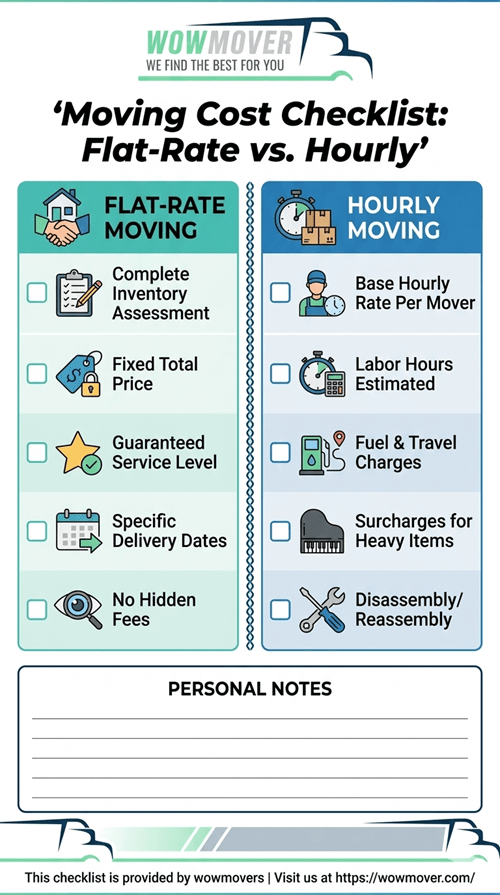
A flat-rate quote is a fixed price agreement between you and the moving company. After evaluating your inventory, distance, and moving requirements, the mover provides one set price for the entire job.
This pricing structure is popular for larger moves because it offers cost certainty upfront.
Flat-rate movers typically conduct a virtual or in-home survey before preparing an estimate. They calculate factors such as:
Once the estimate is finalized, the agreed amount usually stays the same unless you add more belongings or request additional services later.
One of the biggest advantages is knowing your total moving expense ahead of time. This helps with budgeting and reduces financial surprises.
For interstate relocations, flat-rate pricing often works better because travel variables are easier to estimate upfront.
If you’re comparing the best interstate moving and storage options, many national movers prefer fixed-price estimates for cross-country relocations.
Because the price doesn’t change based on time spent loading or unloading, customers feel less pressure during the move.
Some companies build extra padding into fixed quotes to protect themselves against delays or unexpected complications.
If your inventory changes significantly before moving day, the quote may need adjustment.
Hourly moving pricing is based on the amount of time movers spend working. The total cost depends on the hourly labor rate, crew size, truck usage, and total hours required to complete the move.
This model is especially common for local relocations.
Most hourly movers charge:
The final bill increases or decreases depending on how efficiently the move is completed.
If you’re moving from a small apartment or studio nearby, hourly pricing can be cheaper than a fixed-rate estimate.
Hourly movers allow more flexibility if you’re unsure about inventory or timing.
For shorter distances, hourly billing often reflects actual labor costs more accurately.
Unexpected delays like traffic, elevator wait times, parking issues, or disorganized packing can significantly increase the final bill.
Because time estimates are rarely exact, your final total may end up higher than expected.
This is why many customers spend extra time comparing accurate moving quotes before selecting a pricing structure.
There’s no universal answer because the cheaper option depends entirely on your move details. However, certain situations strongly favor one pricing model over the other.
Flat-rate moving generally provides better value when:
Large interstate moves involve many variables that can dramatically affect hourly costs. A fixed estimate protects you from delays that are outside your control.
Hourly rates usually make sense when:
Short-distance moves often take fewer hours than movers estimate, which can lower your overall expense.
No matter which pricing structure you choose, several major factors influence your final moving bill.
Longer moves increase fuel costs, labor requirements, and transportation expenses.
If you’re researching the cost to move to another state , you’ll notice that distance remains one of the largest pricing factors across every moving company.
The more items you move, the more labor and truck space required.
Heavy furniture, appliances, and oversized items increase both hourly and flat-rate estimates.
Professional packing adds convenience but also increases overall costs.
Some movers bundle packing into flat-rate agreements, while hourly movers often charge separately for labor and supplies.
Narrow hallways, multiple staircases, elevators, or limited parking can all increase labor time.
Summer months and weekends usually come with higher demand and higher rates.
For interstate or cross-country relocations, flat-rate pricing is usually safer financially.
Long-distance moves involve variables such as:
With hourly pricing, these factors can create unexpected cost increases. Flat-rate estimates help eliminate much of that uncertainty.
Many customers requesting long distance moving quotes choose fixed pricing specifically for peace of mind.
For short local moves, hourly pricing often provides better value.
If the move can realistically be completed in a few hours, paying only for actual labor time may cost less than a fixed estimate.
This is especially true for:
Homeowners comparing local moving quotes frequently discover that hourly rates offer more flexibility for small-scale moves.
Before signing any agreement, ask movers several important questions.
Binding estimates guarantee the final price unless inventory changes. Non-binding estimates can increase later.
Ask about:
Some movers separate labor and packing costs from transportation fees.
Understanding overtime policies is critical for hourly pricing agreements.
Choosing the right pricing model is only part of controlling moving expenses.
Reducing inventory lowers labor time and truck space requirements.
Scheduling movers several weeks ahead can help you secure lower rates.
Always gather at least three estimates before committing.
When preparing for hiring a moving company, comparing pricing structures side-by-side can reveal hidden fees and service differences.
Label boxes clearly and prepare everything before movers arrive to reduce labor time.
Full-service movers handle packing, loading, transportation, unloading, and sometimes unpacking. While they cost more than DIY moving, they can significantly reduce stress and physical labor.
For busy families, seniors, or professionals managing complex relocations, full-service moving often provides better overall value.
Many homeowners begin their planning process by requesting full service moving quotes to understand what complete relocation support may cost.
The best quote is not always the cheapest one. Reliable service, transparent pricing, and strong communication matter just as much as cost.
To improve your chances of getting a fair estimate:
If you’re starting your move planning process, you can easily get a free quote to compare pricing options and understand what services fit your relocation needs best.
Some companies also offer free moving quotes online, making it easier to compare providers before making a final decision.
Flat-rate moving quotes offer stability, predictability, and better protection against surprise costs, especially for larger or long-distance relocations.
Hourly moving rates, on the other hand, can save money for smaller local moves where timing is easier to estimate and control.
The smartest choice depends on the complexity of your move, your budget flexibility, and how comfortable you are with pricing uncertainty.
For most interstate relocations, flat-rate pricing tends to provide better financial security. For quick local moves, hourly billing may deliver better value.
The key is understanding exactly what’s included in your estimate and choosing a reputable mover with transparent pricing practices.
No, but it often provides better cost predictability for larger or long-distance moves.
Yes, hourly pricing is usually more affordable for short-distance or small moves.
Yes, especially if your inventory or service requirements change before moving day.
It may include packing, loading, transportation, unloading, and unpacking services.
It’s best to compare at least three written estimates before hiring movers.