
Moving Containers
Recommendation
Moving Container Reviews
Recommendation
Truck Rentals Reviews
Storage Recommendations
Storage Review
Junk Removal Recommendations
Junk Removal Reviews
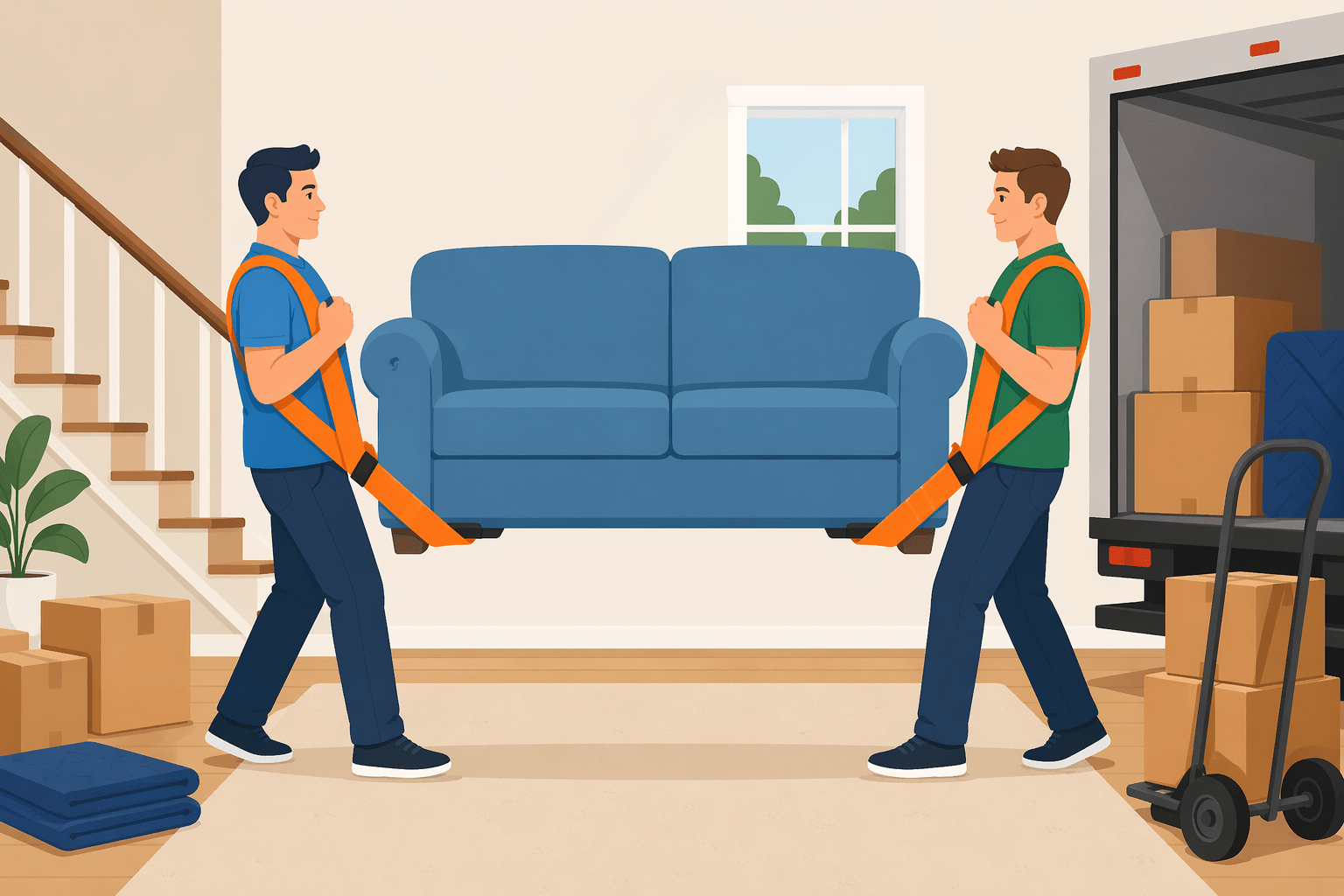

Moving straps can make a difficult move safer, smoother, and far less exhausting. If you are carrying bulky furniture, appliances, or oversized boxes without professional help, moving straps give you more control and reduce the physical strain that usually comes with lifting heavy items. They are especially useful when moving through tight hallways, loading trucks, and handling stairs where balance matters as much as strength.
For anyone planning a DIY move, moving straps are one of the simplest tools you can add to your packing and lifting setup. They help distribute weight more evenly, improve posture while lifting, and make it easier for two people to handle items that would otherwise feel impossible to move. When used correctly, they can lower the chance of back strain and help protect both the people lifting and the furniture being moved.
That said, moving straps are not always intuitive right out of the box. They often look like a bundle of nylon loops and harnesses, and many first-time users are unsure how to position them or when to choose forearm straps over shoulder straps. Once you understand how they work, though, they become one of the most practical moving accessories you can own.
Moving straps, sometimes called furniture lifting straps, are designed to use leverage rather than raw force. Instead of asking your arms and lower back to carry the entire load, the straps shift part of that weight into stronger muscle groups and help two people move as a team.
The basic idea is simple. A strap runs underneath the item being moved, while each person takes one side of the system. Depending on the style, the load is supported by either the forearms or the shoulders. That setup creates better balance, reduces awkward bending, and makes the object feel more manageable.
This matters because many injuries during a move happen when people try to lift with poor posture or twist while carrying something heavy. A couch, dresser, or washing machine may not seem impossible at first, but once it has to be turned through a doorway or lowered down a stairwell, the risk increases fast. Moving straps help keep the item closer to the body and lower the need for sudden, unstable repositioning.
They are also affordable compared with other moving equipment. Forearm strap sets are usually less expensive, while shoulder systems cost more because they are built to support heavier items. For many households, they are worth buying for a single move, especially if several large items need to be carried.
Moving straps are popular for a reason. They do more than make heavy lifting possible. They make the process more controlled.
One of the biggest advantages of moving straps is how they spread the load. Instead of forcing one person to take more weight than the other, the straps help both movers stay aligned. That balance is important when carrying items through narrow spaces or over uneven surfaces.
Lifting without straps often means bending too low, reaching too far, or twisting while trying to get a better grip. Those are exactly the kinds of movements that can lead to back and shoulder injuries. Moving straps reduce those motions by lifting the item from underneath while keeping the body in a stronger position.
A dolly is often the best tool on flat ground, but it is not always practical on stairs or in cramped interiors. Moving straps can be more useful in those situations because they allow two people to move in sync while keeping the item stable.
When a heavy item shifts unexpectedly, it can damage walls, flooring, or the furniture itself. Straps add stability and help both movers respond together, which lowers the chance of sudden slips or awkward impacts.
Moving straps are not the right solution for every single item, but they are extremely useful in common moving situations.
They make the most sense when you need to carry bulky furniture that cannot be easily boxed, rolled, or placed on a dolly. Mattresses, dressers, large chairs, washing machines, and refrigerators are all typical examples. They are also ideal when two people are available and the item needs to travel through staircases, narrow doorways, or apartment corridors.
If you already have a dolly and the item can be safely strapped onto it, that may still be the easier option on level ground. But if the item has to go down stairs or around tight corners, moving straps usually offer more flexibility and safer control.
Forearm moving straps are the simpler of the two main types. Each strap has loops on both ends. One person places a loop over each forearm, while the partner does the same on the opposite side. The strap runs underneath the item, allowing the pair to lift together.
These straps are best for moderately heavy or bulky items that need more control than brute strength. A mattress, smaller dresser, chaise lounge, or medium-sized furniture piece can often be moved effectively with forearm straps.
The advantage of forearm straps is simplicity. They are quick to put on, easy to adjust, and usually less expensive than shoulder systems. They also work well when the item is not excessively heavy but still awkward enough to carry without assistance.
The limitation is strength. Because the load is supported through the forearms and upper body rather than the shoulders and torso, forearm straps are not ideal for extremely heavy appliances. They can help with furniture, but they are usually not the best choice for refrigerators, washers, or oversized safes.
Shoulder moving straps, often referred to as shoulder dolly systems, are designed for heavier lifting. These sets usually include harnesses that go over each mover’s shoulders and connect to a lifting strap that passes under the item.
The main benefit of shoulder straps is that they allow the strongest parts of the body to carry more of the weight. Because the load is distributed through the shoulders and core, two people can move heavier items with better stability and less strain than they would with forearm straps.
Another advantage is hand freedom. With shoulder systems, your hands can still help guide and steady the item while the harness bears much of the load. That added control is useful when maneuvering appliances, large cabinets, or dense wood furniture through doorways and stairwells.
If you are moving especially heavy household items and want a better balance between strength and control, shoulder straps are usually the stronger choice.
Using moving straps correctly matters just as much as owning them. A good tool can still become a problem if it is used with poor technique.
This sounds obvious, but many people skip it. Strap systems vary by brand, especially shoulder harness models. Before lifting anything, check how the loops, buckles, and length adjustments are supposed to sit.
Do a small trial lift first. This helps you confirm that the strap is centered, the load feels balanced, and both people are ready. If the object tilts too much to one side, stop and reposition.
Moving straps work best when both movers act together. Count out the lift, move slowly, and communicate constantly. Sudden movements make the load unstable and increase injury risk.
Before you lift, remove rugs, cords, boxes, and anything else that could become a tripping hazard. Know exactly where you are going and where you will set the item down.
Supportive, non-slip shoes are essential. Slippers, sandals, and socks on hard flooring create unnecessary risk when carrying a heavy load.
If an item is too heavy, too large, or too awkward to control safely, stop. Some moves are better handled by trained professionals with equipment and experience.
Even though moving straps are straightforward once you get used to them, a few mistakes come up again and again.
One common error is choosing the wrong type of strap for the item. People often use forearm straps for loads that really call for shoulder support, which makes the move harder than it needs to be.
Another mistake is setting the strap at the wrong length. If the item hangs too low, you may still have to bend excessively. If it sits too high, the load can become unstable and difficult to steer.
Poor communication is another major problem. Two people may be physically capable of lifting an item, but if one turns too early or lowers too fast, the move can go wrong quickly.
Finally, many DIY movers underestimate how tiring repeated lifting becomes over the course of a full moving day. Even with straps, fatigue builds up. It is important to pace yourself, take breaks, and know when extra help is worth the cost.
Moving straps are a smart investment for smaller or moderately difficult DIY moves, but they are not always the best answer for every situation.
If you are moving a one-bedroom apartment with a few heavy pieces, straps can save money and make the job more manageable. They are also useful when friends or family are helping and you want a safer way to handle bulky items.
But if your move includes multiple flights of stairs, very heavy appliances, antique furniture, or a full household of large items, professional movers may be the better option. Services like All My Sons Moving and Storage, PODS, 1-800-PACK-RAT can reduce the physical risk and time pressure that come with large-scale moves.
There is also a practical middle ground. Some people rent the truck and handle part of the move themselves, then hire labor only for the most difficult items. That approach can be more affordable than full-service moving while still protecting you from the hardest lifting.
For most DIY movers, yes. Moving straps are worth it because they improve safety, reduce strain, and make heavy items easier to control. They are not magic, and they do not eliminate the need for proper lifting technique, but they do give two people a much better mechanical advantage than lifting by hand alone.
They are especially worthwhile if you expect to move more than one large item, deal with stairs, or help friends and family move in the future. A single set can be used again and again, which makes the cost easy to justify.
At the same time, knowing when not to use them is part of using them wisely. If a move feels too risky, too large, or too physically demanding, bringing in professionals is often the smarter decision.
Moving straps are one of the simplest ways to make a DIY move safer and more efficient. They help distribute weight, reduce unnecessary strain, and give two people better control over large furniture and appliances. Whether you choose forearm straps for lighter bulky items or shoulder straps for heavier loads, the key is using them with proper setup, clear communication, and realistic expectations.
If you are planning a move soon, moving straps can be a practical tool that saves time, energy, and stress. And if the lifting side of the job still feels overwhelming, comparing your options between DIY equipment, truck rentals, portable containers, and professional movers can help you choose the right level of support for your situation.
